


Page 120 - Low Temperature Energy Systems with Applications of Renewable Energy
P. 120
Effective use of heat pumps for various heating applications      109

           recovery system of two gas turbines with a capacity of 5.25 MWt/unit. The purpose:
           the absorption refrigeration machine is part of a trigeneration complex which provides
           the airport terminals with electricity, heat energy (heating, ventilation, hot water), and
           cold for air conditioning.
              Other airports with heat pumps include the following:

           •  Airport Bangkok - Refrigeration capacity ¼ 30,000 kW.
           •  John Wayne Airport, Orange County, CA, US - Refrigeration capacity ¼ 3700 kW.
           •  Airport Madrid - Refrigeration capacity ¼ 19,800 kW.
           •  Changsha Airport, China - Refrigerating capacity: 12,200 kW.
           •  Tianjin Binhai Airport, China - Chiller ¼ 10 MW.
           •  Canberra Airport, Australia - Refrigeration capacity ¼ 2100 kW.
           •  Sabiha Gokcen Airport, Istanbul - Refrigerating capacity ¼ 3000 kW.


           3.3.4.2  Office buildings

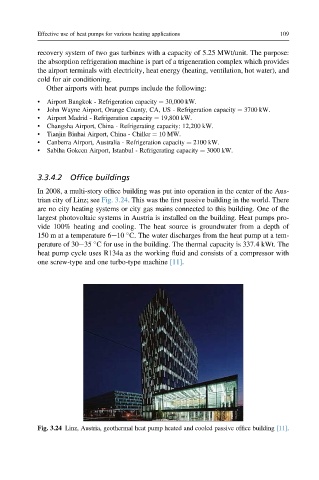
           In 2008, a multi-story office building was put into operation in the center of the Aus-
           trian city of Linz; see Fig. 3.24. This was the first passive building in the world. There
           are no city heating systems or city gas mains connected to this building. One of the
           largest photovoltaic systems in Austria is installed on the building. Heat pumps pro-
           vide 100% heating and cooling. The heat source is groundwater from a depth of

           150 m at a temperature 6e10 C. The water discharges from the heat pump at a tem-

           perature of 30e35 C for use in the building. The thermal capacity is 337.4 kWt. The
           heat pump cycle uses R134a as the working fluid and consists of a compressor with
           one screw-type and one turbo-type machine [11].


           Fig. 3.24 Linz, Austria, geothermal heat pump heated and cooled passive office building [11].

