


Page 122 - Low Temperature Energy Systems with Applications of Renewable Energy
P. 122
Effective use of heat pumps for various heating applications      111

           •  Basurto Hospital Madrid - Refrigeration capacity ¼ 1000 kW
           •  Hospital Echuka, Sydney - Refrigeration capacity ¼ 500 kW
           •  Semmelweiss Hospital, Budapest - Refrigeration capacity ¼ 1128 kW
           •  Radcliffe Hospital, Oxford, UK - Refrigeration capacity ¼ 1000 kW
           •  Medical Resort Chungnam, Yessan, South Korea - Refrigeration capacity ¼ 3489 kW
           •  St. Vincent’s Hospital, Jacksonville, Florida - Refrigeration capacity ¼ 3489 kW
           •  DLF Cyber City, New Delhi - Refrigeration capacity ¼ 70,769 kW
           •  Beijing West Railway Station - Chiller capacity ¼ 12 MW
           •  University Hospital, Bern - Dual-effect chiller capacity ¼ 1.5 MW; uses hot water from
              geothermal sources.


           3.4   Water-loop heat pump systems


           Multi-zone buildings are characterized by different thermal loads that change season-
           ally. The design and selection of equipment for centralized air conditioning systems in
           multi-zone buildings is often based on the maximum potential load, leading to low ef-
           ficiency when conditions of reduced load exist. An effective measure in energy saving
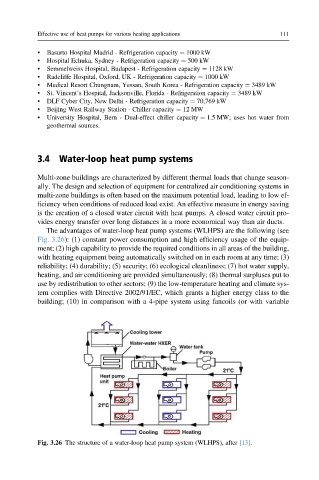
           is the creation of a closed water circuit with heat pumps. A closed water circuit pro-
           vides energy transfer over long distances in a more economical way than air ducts.
              The advantages of water-loop heat pump systems (WLHPS) are the following (see
           Fig. 3.26): (1) constant power consumption and high efficiency usage of the equip-
           ment; (2) high capability to provide the required conditions in all areas of the building,
           with heating equipment being automatically switched on in each room at any time; (3)
           reliability; (4) durability; (5) security; (6) ecological cleanliness; (7) hot water supply,
           heating, and air conditioning are provided simultaneously; (8) thermal surpluses put to
           use by redistribution to other sectors; (9) the low-temperature heating and climate sys-
           tem complies with Directive 2002/91/EC, which grants a higher energy class to the
           building; (10) in comparison with a 4-pipe system using fancoils (or with variable


           Fig. 3.26 The structure of a water-loop heat pump system (WLHPS), after [13].

