Page 377 - MATLAB an introduction with applications
P. 377
362 ———  MATLAB: An Introduction with Applications

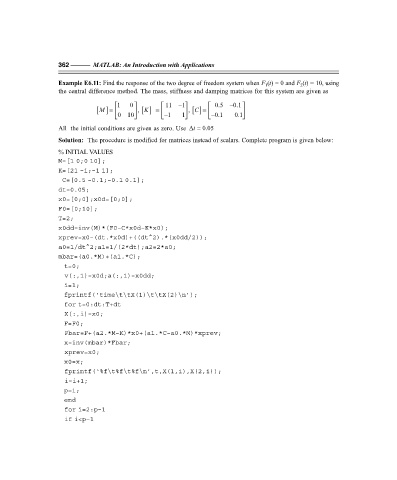
                   Example E6.11: Find the response of the two degree of freedom system when F (t) = 0 and F (t) = 10, using
                                                                                             2
                                                                                   1
                   the central difference method. The mass, stiffness and damping matrices for this system are given as
                                     1      0      11    –1     0.5    –0.1 
                                      [ ] =     , K     , C            
                                             [ ] =
                                                            [ ] =
                                M
                                     0    10      –1       1    –0.1       0.1 
                   All  the initial conditions are given as zero. Use  ∆t =  0.05
                   Solution:  The procedure is modified for matrices instead of scalars. Complete program is given below:
                   % INITIAL VALUES
                   M=[1 0;0 10];
                   K=[21 –1;–1 1];
                     C=[0.5 –0.1;–0.1 0.1];
                   dt=0.05;
                   x0=[0;0];x0d=[0;0];
                   F0=[0;10];
                   T=2;
                   x0dd=inv(M)*(F0–C*x0d–K*x0);
                   xprev=x0–(dt.*x0d)+((dt^2).*(x0dd/2));
                   a0=1/dt^2;a1=1/(2*dt);a2=2*a0;
                   mbar=(a0.*M)+(a1.*C);
                      t=0;
                      v(:,1)=x0d;a(:,1)=x0dd;
                      i=1;
                      fprintf(‘time\t\tX(1)\t\tX(2)\n’);
                      for t=0:dt:T+dt
                      X(:,i)=x0;
                      F=F0;
                      Fbar=F+(a2.*M–K)*x0+(a1.*C–a0.*M)*xprev;
                      x=inv(mbar)*Fbar;
                      xprev=x0;
                      x0=x;
                      fprintf(‘%f\t%f\t%f\n’,t,X(1,i),X(2,i));
                      i=i+1;
                      p=i;
                      end
                      for i=2:p–1
                      if i<p–1
   372   373   374   375   376   377   378   379   380   381   382