


Page 199 - Machinery Component Maintenance
P. 199
Machinery Alignment   181


      ”


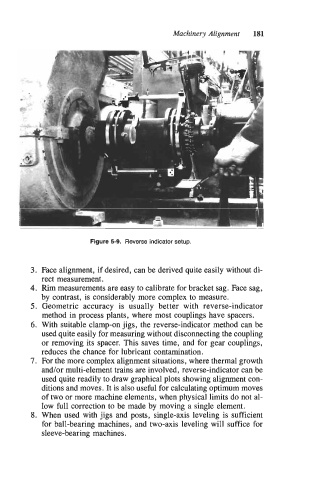
                         Figure 5-9.  Reverse indicator setup.


         3.  Face alignment, if desired, can be derived quite easily without di-
            rect measurement.
         4.  Rim measurements are easy to calibrate for bracket sag. Face sag,
            by contrast, is considerably more complex to measure.
         5.  Geometric  accuracy  is  usually  better  with  reverse-indicator
            method in process plants, where most couplings have spacers.
         6.  With suitable clamp-on jigs, the reverse-indicator method can be
            used quite easily for measuring without disconnecting the coupling
            or removing its spacer. This saves time, and for gear couplings,
            reduces the chance for lubricant contamination.
         7.  For the more complex alignment situations, where thermal growth
            and/or multi-element trains are involved, reverse-indicator can be
            used quite readily to draw graphical plots showing alignment con-
            ditions and moves. It is also useful for calculating optimum moves
            of two or more machine elements, when physical limits do not al-
            low full correction to be made by moving a single element.
         8.  When used with jigs and posts, single-axis leveling is sufficient
            for ball-bearing machines, and two-axis leveling will suffice for
            sleeve-bearing machines.

