


Page 166 - Make Your Own PCBs with EAGLE from Schematic Designs to Finished Boards
P. 166
precautions specified on the equipment and chemicals that you use.


      Photoetching  uses  a  transparency  with  an  image  of  the  PCB  to  be  created  printed  onto
  transparency  film  that  is  then  placed  over  copper-clad  board  that  has  been  presensitized.  These

  boards are not much more expensive than plain boards. The board is then exposed to UV light through
  the transparency film.
      The board is then put into a tray of developer, and the image of the PCB tracks will become
  visible on the board just like an old-fashioned photograph being developed. Next, the board is etched

  in a chemical that dissolves the copper except where it is protected by the photographic image of the
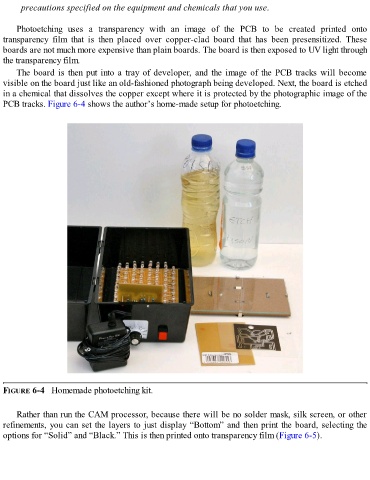
  PCB tracks. Figure 6-4 shows the author’s home-made setup for photoetching.


  FIGURE 6-4   Homemade photoetching kit.


      Rather than run the CAM processor, because there will be no solder mask, silk screen, or other
  refinements, you can set the layers to just display “Bottom” and then print the board, selecting the
  options for “Solid” and “Black.” This is then printed onto transparency film (Figure 6-5).

