


Page 172 - Make Your Own PCBs with EAGLE from Schematic Designs to Finished Boards
P. 172
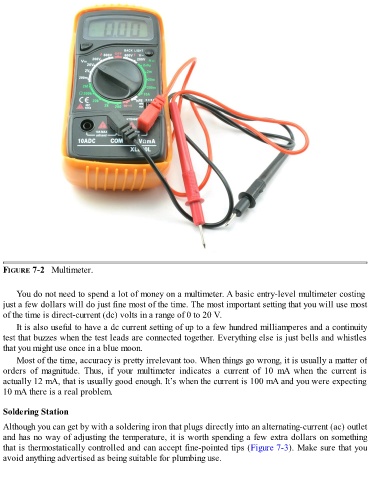
FIGURE 7-2   Multimeter.


      You do not need to spend a lot of money on a multimeter. A basic entry-level multimeter costing
  just a few dollars will do just fine most of the time. The most important setting that you will use most
  of the time is direct-current (dc) volts in a range of 0 to 20 V.

      It is also useful to have a dc current setting of up to a few hundred milliamperes and a continuity
  test that buzzes when the test leads are connected together. Everything else is just bells and whistles
  that you might use once in a blue moon.

      Most of the time, accuracy is pretty irrelevant too. When things go wrong, it is usually a matter of
  orders  of  magnitude.  Thus,  if  your  multimeter  indicates  a  current  of  10  mA  when  the  current  is
  actually 12 mA, that is usually good enough. It’s when the current is 100 mA and you were expecting
  10 mA there is a real problem.


  Soldering Station

  Although you can get by with a soldering iron that plugs directly into an alternating-current (ac) outlet

  and has no way of adjusting the temperature, it is worth spending a few extra dollars on something
  that is thermostatically controlled and can accept fine-pointed tips (Figure 7-3). Make sure that you
  avoid anything advertised as being suitable for plumbing use.

