


Page 174 - Make Your Own PCBs with EAGLE from Schematic Designs to Finished Boards
P. 174
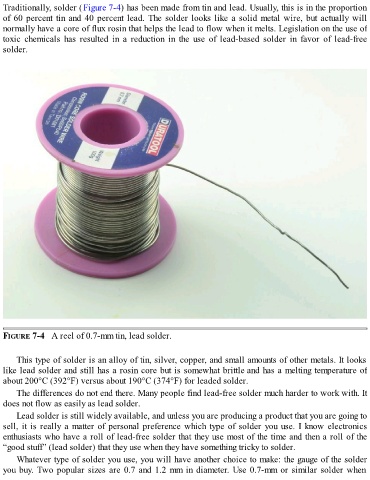
Traditionally, solder (Figure 7-4) has been made from tin and lead. Usually, this is in the proportion
  of 60 percent tin and 40 percent lead. The solder looks like a solid metal wire, but actually will
  normally have a core of flux rosin that helps the lead to flow when it melts. Legislation on the use of
  toxic  chemicals  has  resulted  in  a  reduction  in  the  use  of  lead-based  solder  in  favor  of  lead-free

  solder.


  FIGURE 7-4   A reel of 0.7-mm tin, lead solder.


      This type of solder is an alloy of tin, silver, copper, and small amounts of other metals. It looks
  like lead solder and still has a rosin core but is somewhat brittle and has a melting temperature of
  about 200°C (392°F) versus about 190°C (374°F) for leaded solder.
      The differences do not end there. Many people find lead-free solder much harder to work with. It
  does not flow as easily as lead solder.

      Lead solder is still widely available, and unless you are producing a product that you are going to
  sell, it is really a matter of personal preference which type of solder you use. I know electronics
  enthusiasts who have a roll of lead-free solder that they use most of the time and then a roll of the

  “good stuff” (lead solder) that they use when they have something tricky to solder.
      Whatever type of solder you use, you will have another choice to make: the gauge of the solder
  you buy. Two popular sizes are 0.7 and 1.2 mm in diameter. Use 0.7-mm or similar solder when

