


Page 179 - Make Your Own PCBs with EAGLE from Schematic Designs to Finished Boards
P. 179
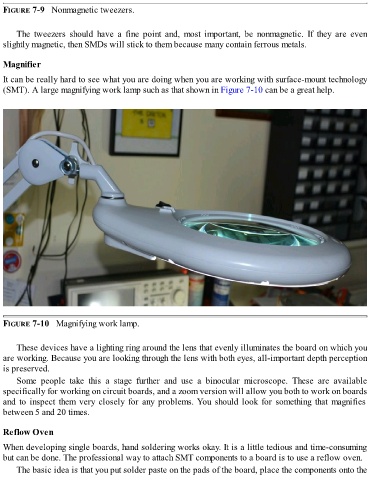
FIGURE 7-9   Nonmagnetic tweezers.


      The  tweezers  should  have  a  fine  point  and,  most  important,  be  nonmagnetic.  If  they  are  even
  slightly magnetic, then SMDs will stick to them because many contain ferrous metals.


  Magnifier

  It can be really hard to see what you are doing when you are working with surface-mount technology
  (SMT). A large magnifying work lamp such as that shown in Figure 7-10 can be a great help.


  FIGURE 7-10   Magnifying work lamp.


      These devices have a lighting ring around the lens that evenly illuminates the board on which you
  are working. Because you are looking through the lens with both eyes, all-important depth perception
  is preserved.

      Some  people  take  this  a  stage  further  and  use  a  binocular  microscope.  These  are  available
  specifically for working on circuit boards, and a zoom version will allow you both to work on boards
  and to inspect them very closely for any problems. You should look for something that magnifies
  between 5 and 20 times.


  Reflow Oven


  When developing single boards, hand soldering works okay. It is a little tedious and time-consuming
  but can be done. The professional way to attach SMT components to a board is to use a reflow oven.
      The basic idea is that you put solder paste on the pads of the board, place the components onto the

