


Page 169 - Managing Global Warming
P. 169
Current and future nuclear power reactors and plants              133


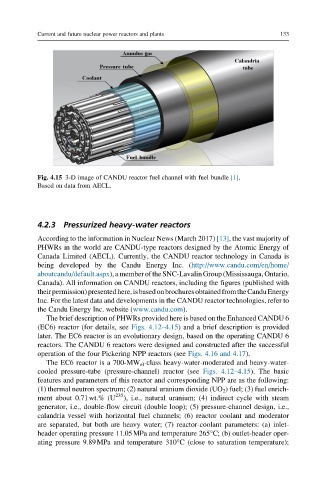
           Fig. 4.15 3-D image of CANDU reactor fuel channel with fuel bundle [1].
           Based on data from AECL.


           4.2.3  Pressurized heavy-water reactors

           According to the information in Nuclear News (March 2017) [13], the vast majority of
           PHWRs in the world are CANDU-type reactors designed by the Atomic Energy of
           Canada Limited (AECL). Currently, the CANDU reactor technology in Canada is
           being developed by the Candu Energy Inc. (http://www.candu.com/en/home/
           aboutcandu/default.aspx), a member of the SNC-Lavalin Group (Mississauga, Ontario,
           Canada). All information on CANDU reactors, including the figures (published with
           theirpermission)presentedhere,isbasedonbrochuresobtainedfromtheCanduEnergy
           Inc. For the latest data and developments in the CANDU reactor technologies, refer to
           the Candu Energy Inc. website (www.candu.com).
              The brief description of PHWRs provided here is based on the Enhanced CANDU 6
           (EC6) reactor (for details, see Figs. 4.12–4.15) and a brief description is provided
           later. The EC6 reactor is an evolutionary design, based on the operating CANDU 6
           reactors. The CANDU 6 reactors were designed and constructed after the successful
           operation of the four Pickering NPP reactors (see Figs. 4.16 and 4.17).
              The EC6 reactor is a 700-MW el -class heavy-water-moderated and heavy-water-
           cooled pressure-tube (pressure-channel) reactor (see Figs. 4.12–4.15). The basic
           features and parameters of this reactor and corresponding NPP are as the following:
           (1) thermal neutron spectrum; (2) natural uranium dioxide (UO 2 ) fuel; (3) fuel enrich-
           ment about 0.71wt.% (U 235 ), i.e., natural uranium; (4) indirect cycle with steam
           generator, i.e., double-flow circuit (double loop); (5) pressure-channel design, i.e.,
           calandria vessel with horizontal fuel channels; (6) reactor coolant and moderator
           are separated, but both are heavy water; (7) reactor-coolant parameters: (a) inlet-
           header operating pressure 11.05MPa and temperature 265°C; (b) outlet-header oper-
           ating pressure 9.89MPa and temperature 310°C (close to saturation temperature);

