


Page 524 - Marine Structural Design
P. 524
500                                                   Part IV Structural Reliabilig

                   28.3  Reliability Updating Theory for Probability-Based Inspection Planning
                   28.3.1  General

                   Baysian  models  have been  applied to  reliability updating  for probability-based  inspection
                   planning. This Section shall present two major approaches that have been developed in the pat
                   30 years.
                   Updating Through Inspection Events to  update the probability of events such as fatigue
                   failure directly, (Yang,  1976, Itagaki et al,  1983, Madsen,  1986, Moan,  1993 & 1997). A
                   simplified Bayesian method that only considers crack initiation, propagation and detection as
                   random  variables and  independent  components  in  a  series system was  proposed by Yang
                   (1976) and Itagaki et a1 (1983).
                   Updating Through Variables to re-calculate failure probability using the updated probability
                    distributions for defect size etc. (Shinozuka and Deodatis,  1989). The change in reliability
                    index  is caused by the changes in  random variables. The distribution of a variable can be
                   updated based on  inspection events. When the variables are updated, the failure probability
                   can be easily calculated using the updated variables. However, if several variables are updated
                   based on the same inspection event, the increased correlation between the updated variables
                    should be accounted for.
                   The approach for updating through inspection events will be further explained in the next sub-
                    section.

                   28.3.2  Inspection Planning for Fatigue Damage
                    Fatigue  failure  is  defined  as the  fatigue crack  growth reaches  the  critical  size,  e.g.  wall
                    thickness of the pipe. Based on fracture mechanics, the criterion is written in terms of the
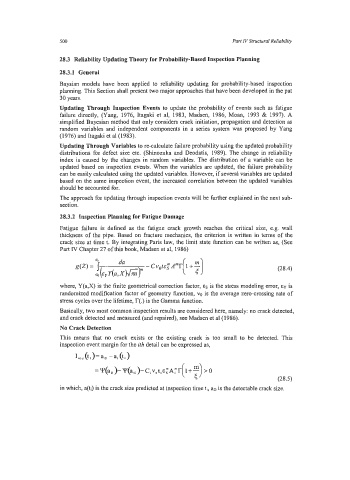
                    crack size at time t. By integrating Pans law, the limit state function can be written as, (See
                    Part IV Chapter 27 of this book, Madsen et al, 1986)


                                                                                        (28.4)

                    where, Y(a,X)  is the finite geometrical correction factor, ES is the stress modeling error, EY is
                   randomized modification factor of geometry function, vo is the average zero-crossing rate of
                    stress cycles over the lifetime, r(.) is the Gamma function.
                    Basically, two most common inspection results are considered here, namely: no crack detected,
                    and crack detected and measured (and repaired), see Madsen et a1 (1986).
                    No Crack Detection
                    This  means  that  no  crack  exists or  the  existing crack  is  too  small  to  be  detected. This
                    inspection event margin for the ith detail can be expressed as,


                                                                                        (28.5)
                    in which, a(ti) is the crack size predicted at inspection time ti, aD is the detectable crack size.

