


Page 526 - Marine Structural Design
P. 526
502                                                   Pari IV Structural Reliability


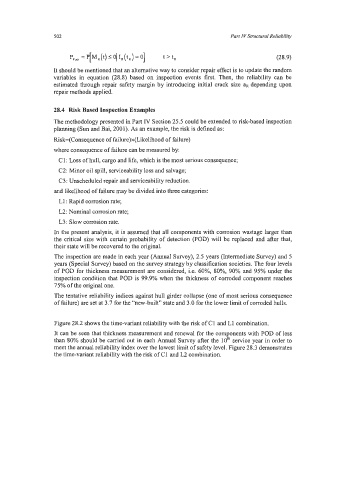
                      PF,,  = P[M,(t)  5 4 IR(tR) = 01   t > t,                      (28.9)

                 It should be mentioned that an alternative way to consider repair effect is to update the random
                 variables  in  equation (28.8) based  on  inspection events  first. Then,  the  reliability can  be
                 estimated through repair safety margin by introducing initial crack size aR  depending upon
                 repair methods applied.

                 28.4  Risk Based Inspection Examples
                 The methodology presented in Part IV Section 25.5 could be extended to risk-based inspection
                 planning (Sun and Bai, 2001). As an example, the risk is defined as:
                 Risk=(Consequence  of failure)x(Likelihood of failure)
                 where consequence of failure can be measured by:
                   C1: Loss of hull, cargo and life, which is the most serious consequence;
                   C2: Minor oil spill, serviceability loss and salvage;
                   C3: Unscheduled repair and serviceability reduction.
                 and likelihood of failure may be divided into three categories:
                   L1: Rapid corrosion rate;
                   L2: Nominal corrosion rate;
                   L3: Slow corrosion rate.
                 In the present analysis, it is assumed that all components with corrosion wastage larger than
                 the critical size with certain probability of detection (POD) will be replaced and after that,
                 their state will be recovered to the original.
                 The inspection are made in each year (Annual Survey), 2.5 years (Intermediate Survey) and 5
                 years (Special Survey) based on the survey strategy by classification societies. The four levels
                 of POD for thickness measurement are considered, i.e. 60%, SO%, 90% and 95% under the
                 inspection condition that POD is 99.9% when the thickness of corroded component reaches
                 75% of the original one.
                 The tentative reliability indices against hull girder collapse (one of most serious consequence
                 of failure) are set at 3.7 for the “new-built” state and 3.0 for the lower limit of corroded hulls.


                 Figure 28.2 shows the time-variant reliability with the risk of C1 and L1 combination.
                 It can be seen that thickness measurement and renewal for the components with POD of less
                 than 80% should be carried out in each Annual Survey after the loth service year in order to
                 meet the annual reliability index over the lowest limit of safety level. Figure 28.3 demonstrates
                 the time-variant reliability with the risk of C1 and L2 combination.

