


Page 424 - Marketing Management
P. 424
DEVELOPING PRICING STRATEGIES AND PROGRAMS | CHAPTER 14           401


           promotion-oriented competitors. In high-low pricing, the retailer charges higher prices on an
           everyday basis but runs frequent promotions with prices temporarily lower than the EDLP level. 60
           These two strategies have been shown to affect consumer price judgments—deep discounts
           (EDLP) can lead customers to perceive lower prices over time than frequent, shallow discounts
           (high-low), even if the actual averages are the same. 61
              In recent years, high-low pricing has given way to EDLP at such widely different venues as
           Toyota Scion car dealers and upscale department stores such as Nordstrom, but the king of EDLP is
           surely Walmart, which practically defined the term. Except for a few sale items every month,
           Walmart promises everyday low prices on major brands.
              EDLP provides customer benefits of time and money. Toyota believes its Gen Y target dislikes
           haggling because it takes too long. These buyers collect a lot of information online anyway, so
           Toyota cut the time to sell Scions from the industry average of 4.5 hours to 45 minutes requiring
           fewer managers to approve negotiated prices and less advertising of sales. 62  Some retailers base
           their entire marketing strategy around extreme everyday low pricing.


                    Dollar Stores         Once-unfashionable “dollar stores” such as Dollar General,
                    Family Dollar, Big Lots, and Dollar Tree are gaining popularity, partly fueled by an economic
                    downturn. In 2008, these four biggest players in the category generated $26 billion in sales
                    with 20,000 stores and gross margins of 35 percent to 40 percent. These ultradiscounters
                    are not dollar stores in a strict sense of the word—they sell many items over $1, although
           most are under $10. They have, however, developed a simple, successful formula for drawing shoppers
           from Target and even Walmart: Build small, easy-to-navigate stores in expensive real estate locations
           with parking handy; keep overhead low by limiting inventory to mostly in-
           expensive overstocks, odd lots, and buyouts; and spend sparingly on
           store décor and get free word-of-mouth publicity. Because most cus-
           tomers pay in person and in cash, dollar stores can avoid the expense of
           processing a lot of credit card purchases and elaborate Internet market-
           ing or supporting a significant e-commerce presence online. 63

              The most important reason retailers adopt EDLP is that con-
           stant sales and promotions are costly and have eroded consumer
           confidence in everyday shelf prices. Consumers also have less
           time and patience for past traditions like watching for supermar-
           ket specials and clipping coupons. Yet, promotions do create
           excitement and draw shoppers, so EDLP does not guarantee
           success. As supermarkets face heightened competition from their
           counterparts and alternative channels, many find the key is a
           combination of high-low and everyday low pricing strategies,
           with increased advertising and promotions.
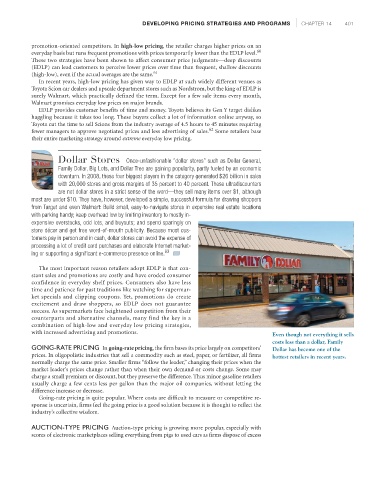
                                                                                         Even though not everything it sells
                                                                                         costs less than a dollar, Family
           GOING-RATE PRICING In going-rate pricing, the firm bases its price largely on competitors’  Dollar has become one of the
           prices. In oligopolistic industries that sell a commodity such as steel, paper, or fertilizer, all firms  hottest retailers in recent years.
           normally charge the same price. Smaller firms “follow the leader,” changing their prices when the
           market leader’s prices change rather than when their own demand or costs change. Some may
           charge a small premium or discount, but they preserve the difference. Thus minor gasoline retailers
           usually charge a few cents less per gallon than the major oil companies, without letting the
           difference increase or decrease.
              Going-rate pricing is quite popular. Where costs are difficult to measure or competitive re-
           sponse is uncertain, firms feel the going price is a good solution because it is thought to reflect the
           industry’s collective wisdom.

           AUCTION-TYPE PRICING Auction-type pricing is growing more popular, especially with
           scores of electronic marketplaces selling everything from pigs to used cars as firms dispose of excess

