


Page 421 - Marketing Management
P. 421
398    PART 5    SHAPING THE MARKET OFFERINGS


        |Fig. 14.5|                         1,200

        Break-Even Chart for                1,000                                                Total revenue
                                           Dollars (in thousands)  600  Break-even point
        Determining Target-                  800                                                 Target profit
        Return Price and                                                                         Total cost
        Break-Even Volume                    400


                                             200                                                 Fixed cost

                                                0       10      20      30       40      50
                                                                  Sales Volume in Units (thousands)


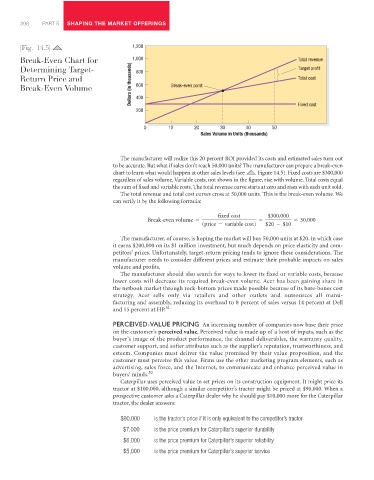
                                        The manufacturer will realize this 20 percent ROI provided its costs and estimated sales turn out
                                      to be accurate. But what if sales don’t reach 50,000 units? The manufacturer can prepare a break-even
                                      chart to learn what would happen at other sales levels (see   Figure 14.5). Fixed costs are $300,000
                                      regardless of sales volume. Variable costs, not shown in the figure, rise with volume. Total costs equal
                                      the sum of fixed and variable costs. The total revenue curve starts at zero and rises with each unit sold.
                                        The total revenue and total cost curves cross at 30,000 units. This is the break-even volume. We
                                      can verify it by the following formula:

                                                                        fixed cost      $300,000
                                                 Break-even volume =                 =          = 30,000
                                                                  (price - variable cost)  $20 - $10

                                        The manufacturer, of course, is hoping the market will buy 50,000 units at $20, in which case
                                      it earns $200,000 on its $1 million investment, but much depends on price elasticity and com-
                                      petitors’ prices. Unfortunately, target-return pricing tends to ignore these considerations. The
                                      manufacturer needs to consider different prices and estimate their probable impacts on sales
                                      volume and profits.
                                        The manufacturer should also search for ways to lower its fixed or variable costs, because
                                      lower costs will decrease its required break-even volume. Acer has been gaining share in
                                      the netbook market through rock-bottom prices made possible because of its bare-bones cost
                                      strategy. Acer sells only via retailers and other outlets and outsources all manu-
                                      facturing and assembly, reducing its overhead to 8 percent of sales versus 14 percent at Dell
                                      and 15 percent at HP. 51

                                      PERCEIVED-VALUE PRICING An increasing number of companies now base their price
                                      on the customer’s perceived value. Perceived value is made up of a host of inputs, such as the
                                      buyer’s image of the product performance, the channel deliverables, the warranty quality,
                                      customer support, and softer attributes such as the supplier’s reputation, trustworthiness, and
                                      esteem. Companies must deliver the value promised by their value proposition, and the
                                      customer must perceive this value. Firms use the other marketing program elements, such as
                                      advertising, sales force, and the Internet, to communicate and enhance perceived value in
                                      buyers’ minds. 52
                                        Caterpillar uses perceived value to set prices on its construction equipment. It might price its
                                      tractor at $100,000, although a similar competitor’s tractor might be priced at $90,000. When a
                                      prospective customer asks a Caterpillar dealer why he should pay $10,000 more for the Caterpillar
                                      tractor, the dealer answers:

                                        $90,000    is the tractor’s price if it is only equivalent to the competitor’s tractor
                                         $7,000    is the price premium for Caterpillar’s superior durability
                                         $6,000    is the price premium for Caterpillar’s superior reliability

                                         $5,000    is the price premium for Caterpillar’s superior service

