


Page 418 - Marketing Management
P. 418
DEVELOPING PRICING STRATEGIES AND PROGRAMS | CHAPTER 14           395


                    Aldi Germany’s Aldi follows a simple formula globally. It stocks only about 1,000 of the
               Aldi  most popular everyday grocery and household items, compared with more than 20,000 at a tra-
                    ditional grocer such as Royal Ahold’s Albert Heijn. Almost all the products carry Aldi’s own exclu-
                    sive label. Because it sells so few items, Aldi can exert strong control over quality and price and
                    simplify shipping and handling, leading to high margins. With more than 8,200 stores worldwide
           currently,Aldi brings in almost $60 billion in annual sales. 47


           Step 4: Analyzing Competitors’ Costs, Prices,
           and Offers
           Within the range of possible prices determined by market demand and company costs, the firm
           must take competitors’ costs, prices, and possible price reactions into account. If the firm’s offer
           contains features not offered by the nearest competitor, it should evaluate their worth to the cus-
           tomer and add that value to the competitor’s price. If the competitor’s offer contains some features
           not offered by the firm, the firm should subtract their value from its own price. Now the firm can
           decide whether it can charge more, the same, or less than the competitor.
              The introduction or change of any price can provoke a response from customers, competitors,
           distributors, suppliers, and even government. Competitors are most likely to react when the number
           of firms is few, the product is homogeneous, and buyers are highly informed. Competitor reactions
           can be a special problem when these firms have a strong value proposition, as Green Works did.


               Green Works  Green Works    Although the natural cleaner market was pioneered by    High Price
                    Seventh Generation and method cleaning products, Clorox Green Works now commands
                    42 percent market share. The Green Works product line consists of 10 natural cleaners
                                                                                                  (No possible
                    using biodegradable ingredients, packaged in recyclable materials, and not tested on
                                                                                                   demand at
                    animals. The first major new Clorox brand in more than 20 years, it doubled the size of  this price)
           the natural cleaning category with its strategy of “delivering a line of affordable products that are
           good for consumers, good for retailers, and good for the environment.” The company charges only a  Ceiling
           10 percent to 20 percent premium over conventional cleaners, versus the premium of 40 percent or  price
           more charged by other natural cleaners. Launch marketing efforts included the use of viral market-  Customers’
                                                                                                   assessment
           ing and social media, prominent TV coverage in shows like Ellen and Oprah, collaborations with retail
                                                                                                   of unique
           customers such as Safeway and Walmart in product development and in-store promotion, and an en-  product
           dorsement from and cause marketing program with the Sierra Club (resulting in a donation of  features
           $645,000 to the organization in 2009). 48                                               Orienting
                                                                                                     point
              How can a firm anticipate a competitor’s reactions? One way is to assume the competitor reacts
                                                                                                  Competitors’
           in the standard way to a price being set or changed. Another is to assume the competitor treats each  prices and
           price difference or change as a fresh challenge and reacts according to self-interest at the time. Now  prices of
           the company will need to research the competitor’s current financial situation, recent sales, cus-  substitutes
           tomer loyalty, and corporate objectives. If the competitor has a market share objective, it is likely to  Costs
                                      49
           match price differences or changes. If it has a profit-maximization objective, it may react by in-
           creasing its advertising budget or improving product quality.                            Floor
              The problem is complicated because the competitor can put different interpretations on  price
           lowered prices or a price cut: that the company is trying to steal the market, that it is doing
           poorly and trying to boost its sales, or that it wants the whole industry to reduce prices to stimu-  Low Price
           late total demand.                                                                     (No possible
                                                                                                    profit at
                                                                                                   this price)
           Step 5: Selecting a Pricing Method
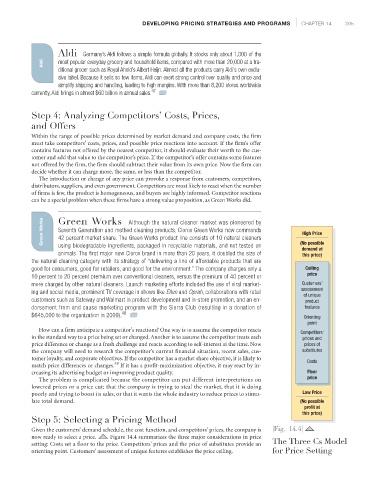
           Given the customers’ demand schedule, the cost function, and competitors’ prices, the company is  |Fig. 14.4|
           now ready to select a price.  Figure 14.4 summarizes the three major considerations in price
           setting: Costs set a floor to the price. Competitors’ prices and the price of substitutes provide an  The Three Cs Model
           orienting point. Customers’ assessment of unique features establishes the price ceiling.  for Price Setting

