


Page 413 - Marketing Management
P. 413
390    PART 5    SHAPING THE MARKET OFFERINGS


                                                costs fall with accumulated production experience; and (3) a low price discourages
                                                actual and potential competition.

                                                MAXIMUM MARKET SKIMMING Companies unveiling a new technology
                                                favor setting high prices to  maximize market skimming. Sony is a frequent
                                                practitioner of market-skimming pricing, in which prices start high and slowly
                                                drop over time. When Sony introduced the world’s first high-definition television
                                                (HDTV) to the Japanese market in 1990, it was priced at $43,000. So that Sony could
                                                “skim” the maximum amount of revenue from the various segments of the market,
                                                the price dropped steadily through the years—a 28-inch Sony HDTV cost just over
                                                $6,000 in 1993, but a 40-inch Sony HDTV cost only $600 in 2010.
                                                   This strategy can be fatal, however, if a worthy competitor decides to price low.
                                                When Philips, the Dutch electronics manufacturer, priced its videodisc players to
                                                make a profit on each, Japanese competitors priced low and rapidly built their mar-
                                                ket share, which in turn pushed down their costs substantially.
                                                   Moreover, consumers who buy early at the highest prices may be dissatisfied if
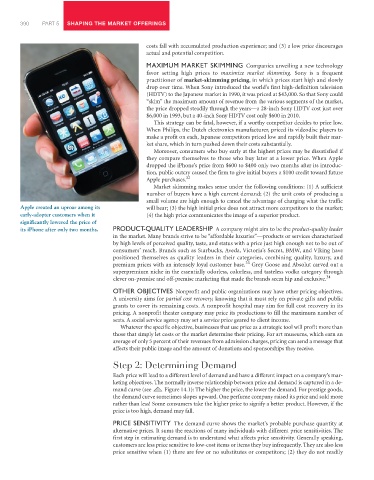
                                                they compare themselves to those who buy later at a lower price. When Apple
                                                dropped the iPhone’s price from $600 to $400 only two months after its introduc-
                                                tion, public outcry caused the firm to give initial buyers a $100 credit toward future
                                                Apple purchases. 32
                                                   Market skimming makes sense under the following conditions: (1) A sufficient
                                                number of buyers have a high current demand; (2) the unit costs of producing a
                                                small volume are high enough to cancel the advantage of charging what the traffic
        Apple created an uproar among its       will bear; (3) the high initial price does not attract more competitors to the market;
        early-adopter customers when it         (4) the high price communicates the image of a superior product.
        significantly lowered the price of
        its iPhone after only two months.  PRODUCT-QUALITY LEADERSHIP A company might aim to be the product-quality leader
                                      in the market. Many brands strive to be “affordable luxuries”—products or services characterized
                                      by high levels of perceived quality, taste, and status with a price just high enough not to be out of
                                      consumers’ reach. Brands such as Starbucks, Aveda, Victoria’s Secret, BMW, and Viking have
                                      positioned themselves as quality leaders in their categories, combining quality, luxury, and
                                      premium prices with an intensely loyal customer base. 33  Grey Goose and Absolut carved out a
                                      superpremium niche in the essentially odorless, colorless, and tasteless vodka category through
                                      clever on-premise and off-premise marketing that made the brands seem hip and exclusive. 34
                                      OTHER OBJECTIVES Nonprofit and public organizations may have other pricing objectives.
                                      A university aims for partial cost recovery, knowing that it must rely on private gifts and public
                                      grants to cover its remaining costs. A nonprofit hospital may aim for full cost recovery in its
                                      pricing. A nonprofit theater company may price its productions to fill the maximum number of
                                      seats. A social service agency may set a service price geared to client income.
                                        Whatever the specific objective, businesses that use price as a strategic tool will profit more than
                                      those that simply let costs or the market determine their pricing. For art museums, which earn an
                                      average of only 5 percent of their revenues from admission charges, pricing can send a message that
                                      affects their public image and the amount of donations and sponsorships they receive.

                                      Step 2: Determining Demand
                                      Each price will lead to a different level of demand and have a different impact on a company’s mar-
                                      keting objectives. The normally inverse relationship between price and demand is captured in a de-
                                      mand curve (see   Figure 14.1): The higher the price, the lower the demand. For prestige goods,
                                      the demand curve sometimes slopes upward. One perfume company raised its price and sold more
                                      rather than less! Some consumers take the higher price to signify a better product. However, if the
                                      price is too high, demand may fall.
                                      PRICE SENSITIVITY The demand curve shows the market’s probable purchase quantity at
                                      alternative prices. It sums the reactions of many individuals with different price sensitivities. The
                                      first step in estimating demand is to understand what affects price sensitivity. Generally speaking,
                                      customers are less price sensitive to low-cost items or items they buy infrequently. They are also less
                                      price sensitive when (1) there are few or no substitutes or competitors; (2) they do not readily

