


Page 412 - Marketing Management
P. 412
DEVELOPING PRICING STRATEGIES AND PROGRAMS | CHAPTER 14           389


           Setting the Price

           A firm must set a price for the first time when it develops a new
           product, when it introduces its regular product into a new distri-
           bution channel or geographical area, and when it enters bids on
           new contract work. The firm must decide where to position its
           product on quality and price.
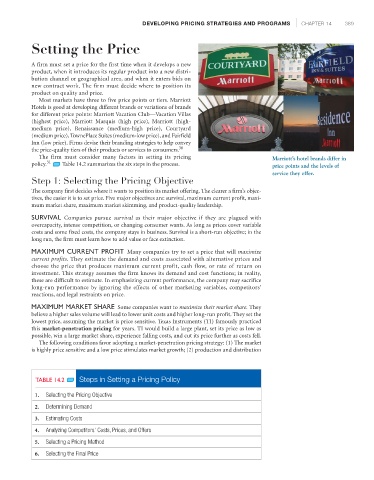
              Most markets have three to five price points or tiers. Marriott
           Hotels is good at developing different brands or variations of brands
           for different price points: Marriott Vacation Club—Vacation Villas
           (highest price), Marriott Marquis (high price), Marriott (high-
           medium price), Renaissance (medium-high price), Courtyard
           (medium price), TownePlace Suites (medium-low price), and Fairfield
           Inn (low price). Firms devise their branding strategies to help convey
           the price-quality tiers of their products or services to consumers. 30
              The firm must consider many factors in setting its pricing                 Marriott’s hotel brands differ in
           policy. 31  Table 14.2 summarizes the six steps in the process.               price points and the levels of
                                                                                         service they offer.
           Step 1: Selecting the Pricing Objective
           The company first decides where it wants to position its market offering. The clearer a firm’s objec-
           tives, the easier it is to set price. Five major objectives are: survival, maximum current profit, maxi-
           mum market share, maximum market skimming, and product-quality leadership.

           SURVIVAL Companies pursue  survival as their major objective if they are plagued with
           overcapacity, intense competition, or changing consumer wants. As long as prices cover variable
           costs and some fixed costs, the company stays in business. Survival is a short-run objective; in the
           long run, the firm must learn how to add value or face extinction.
           MAXIMUM CURRENT PROFIT Many companies try to set a price that will maximize
           current profits. They estimate the demand and costs associated with alternative prices and
           choose the price that produces maximum current profit, cash flow, or rate of return on
           investment. This strategy assumes the firm knows its demand and cost functions; in reality,
           these are difficult to estimate. In emphasizing current performance, the company may sacrifice
           long-run performance by ignoring the effects of other marketing variables, competitors’
           reactions, and legal restraints on price.

           MAXIMUM MARKET SHARE Some companies want to maximize their market share. They
           believe a higher sales volume will lead to lower unit costs and higher long-run profit. They set the
           lowest price, assuming the market is price sensitive. Texas Instruments (TI) famously practiced
           this market-penetration pricing for years. TI would build a large plant, set its price as low as
           possible, win a large market share, experience falling costs, and cut its price further as costs fell.
              The following conditions favor adopting a market-penetration pricing strategy: (1) The market
           is highly price sensitive and a low price stimulates market growth; (2) production and distribution


             TABLE 14.2    Steps in Setting a Pricing Policy

            1.  Selecting the Pricing Objective

            2.  Determining Demand
            3.  Estimating Costs
            4.  Analyzing Competitors’ Costs, Prices, and Offers

            5.  Selecting a Pricing Method
            6.  Selecting the Final Price

