


Page 414 - Marketing Management
P. 414
DEVELOPING PRICING STRATEGIES AND PROGRAMS | CHAPTER 14           391


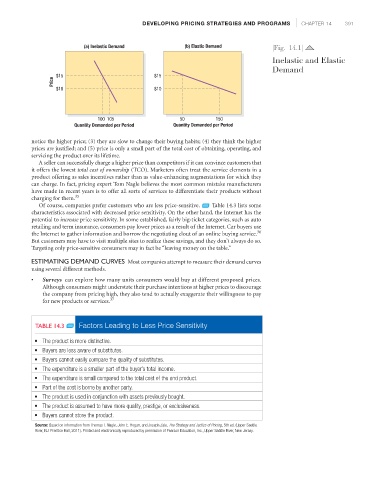
                            (a) Inelastic Demand             (b) Elastic Demand          |Fig. 14.1|

                                                                                         Inelastic and Elastic
                                                                                         Demand
                   $15                             $15
                  Price
                   $10                             $10


                                 100  105                  50          150
                         Quantity Demanded per Period    Quantity Demanded per Period

           notice the higher price; (3) they are slow to change their buying habits; (4) they think the higher
           prices are justified; and (5) price is only a small part of the total cost of obtaining, operating, and
           servicing the product over its lifetime.
              A seller can successfully charge a higher price than competitors if it can convince customers that
           it offers the lowest total cost of ownership (TCO). Marketers often treat the service elements in a
           product offering as sales incentives rather than as value-enhancing augmentations for which they
           can charge. In fact, pricing expert Tom Nagle believes the most common mistake manufacturers
           have made in recent years is to offer all sorts of services to differentiate their products without
           charging for them. 35
              Of course, companies prefer customers who are less price-sensitive.  Table 14.3 lists some
           characteristics associated with decreased price sensitivity. On the other hand, the Internet has the
           potential to increase price sensitivity. In some established, fairly big-ticket categories, such as auto
           retailing and term insurance, consumers pay lower prices as a result of the Internet. Car buyers use
           the Internet to gather information and borrow the negotiating clout of an online buying service. 36
           But customers may have to visit multiple sites to realize these savings, and they don’t always do so.
           Targeting only price-sensitive consumers may in fact be “leaving money on the table.”
           ESTIMATING DEMAND CURVES Most companies attempt to measure their demand curves
           using several different methods.
           •   Surveys can explore how many units consumers would buy at different proposed prices.
               Although consumers might understate their purchase intentions at higher prices to discourage
               the company from pricing high, they also tend to actually exaggerate their willingness to pay
               for new products or services. 37


            TABLE 14.3     Factors Leading to Less Price Sensitivity
            • The product is more distinctive.
            • Buyers are less aware of substitutes.
            • Buyers cannot easily compare the quality of substitutes.
            • The expenditure is a smaller part of the buyer’s total income.
            • The expenditure is small compared to the total cost of the end product.
            • Part of the cost is borne by another party.
            • The product is used in conjunction with assets previously bought.
            • The product is assumed to have more quality, prestige, or exclusiveness.
            • Buyers cannot store the product.
            Source: Based on information from Thomas T. Nagle, John E. Hogan, and Joseph Zale, The Strategy and Tactics of Pricing, 5th ed. (Upper Saddle
            River, NJ: Prentice Hall, 2011). Printed and electronically reproduced by permission of Pearson Education, Inc., Upper Saddle River, New Jersey.

