


Page 417 - Marketing Management
P. 417
394    PART 5    SHAPING THE MARKET OFFERINGS


                                      makes $2 profit per unit, A makes $1 per unit, and B breaks even. The smart move for TI would be
                                      to lower its price to $9. This will drive B out of the market, and even A may consider leaving. TI
                                      will pick up the business that would have gone to B (and possibly A). Furthermore, price-sensitive
                                      customers will enter the market at the lower price. As production increases beyond 400,000 units,
                                      TI’s costs will drop still further and faster and will more than restore its profits, even at a price of
                                      $9. TI has used this aggressive pricing strategy repeatedly to gain market share and drive others
                                      out of the industry.
                                        Experience-curve pricing nevertheless carries major risks. Aggressive pricing might give the
                                      product a cheap image. It also assumes competitors are weak followers. The strategy leads the com-
                                      pany to build more plants to meet demand, but a competitor may choose to innovate with a lower-
                                      cost technology. The market leader is now stuck with the old technology.
                                        Most experience-curve pricing has focused on manufacturing costs, but all costs can be im-
                                      proved on, including marketing costs. If three firms are each investing a large sum of money in
                                      marketing, the firm that has used it longest might achieve the lowest costs. This firm can charge a
                                      little less for its product and still earn the same return, all other costs being equal. 43

                                      TARGET COSTING Costs change with production scale and experience. They can also change
                                      as a result of a concentrated effort by designers, engineers, and purchasing agents to reduce them
                                      through target costing. 44  Market research establishes a new product’s desired functions and the
                                      price at which it will sell, given its appeal and competitors’ prices. This price less desired profit
                                      margin leaves the target cost the marketer must achieve.
                                        The firm must examine each cost element—design, engineering, manufacturing, sales—and
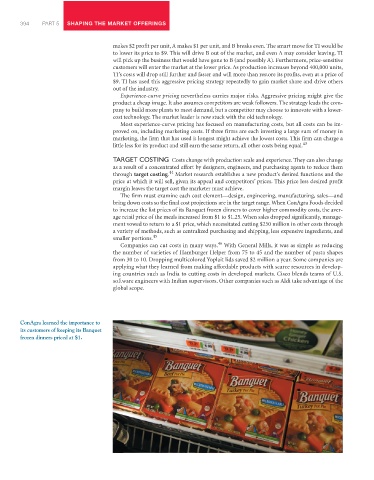
                                      bring down costs so the final cost projections are in the target range. When ConAgra Foods decided
                                      to increase the list prices of its Banquet frozen dinners to cover higher commodity costs, the aver-
                                      age retail price of the meals increased from $1 to $1.25. When sales dropped significantly, manage-
                                      ment vowed to return to a $1 price, which necessitated cutting $250 million in other costs through
                                      a variety of methods, such as centralized purchasing and shipping, less expensive ingredients, and
                                      smaller portions. 45
                                        Companies can cut costs in many ways. 46  With General Mills, it was as simple as reducing
                                      the number of varieties of Hamburger Helper from 75 to 45 and the number of pasta shapes
                                      from 30 to 10. Dropping multicolored Yoplait lids saved $2 million a year. Some companies are
                                      applying what they learned from making affordable products with scarce resources in develop-
                                      ing countries such as India to cutting costs in developed markets. Cisco blends teams of U.S.
                                      software engineers with Indian supervisors. Other companies such as Aldi take advantage of the
                                      global scope.


        ConAgra learned the importance to
        its customers of keeping its Banquet
        frozen dinners priced at $1.

