


Page 422 - Marketing Management
P. 422
DEVELOPING PRICING STRATEGIES AND PROGRAMS | CHAPTER 14           399


              $2,000    is the price premium for Caterpillar’s longer warranty on parts

            $110,000    is the normal price to cover Caterpillar’s superior value
            – $10,000   discount
            $100,000    final price


              The Caterpillar dealer is able to show that although the customer is asked to pay a $10,000 pre-
           mium, he is actually getting $20,000 extra value! The customer chooses the Caterpillar tractor be-
           cause he is convinced its lifetime operating costs will be lower.
              Ensuring that customers appreciate the total value of a product or service offering is crucial.
           Consider the experience of PACCAR.


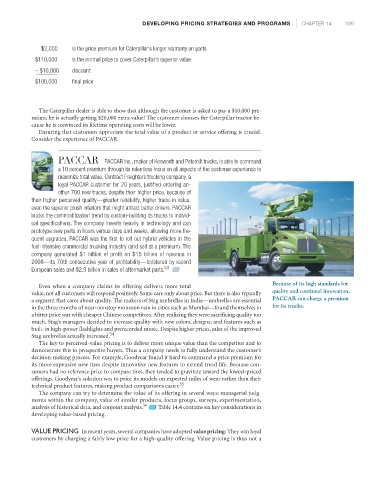
                    PACCAR PACCAR Inc., maker of Kenworth and Peterbilt trucks, is able to command
                    a 10 percent premium through its relentless focus on all aspects of the customer experience to
                    maximize total value. Contract Freighters trucking company, a
                    loyal PACCAR customer for 20 years, justified ordering an-
                    other 700 new trucks, despite their higher price, because of
           their higher perceived quality—greater reliability, higher trade-in value,
           even the superior plush interiors that might attract better drivers. PACCAR
           bucks the commoditization trend by custom-building its trucks to individ-
           ual specifications. The company invests heavily in technology and can
           prototype new parts in hours versus days and weeks, allowing more fre-
           quent upgrades. PACCAR was the first to roll out hybrid vehicles in the
           fuel-intensive commercial trucking industry (and sell at a premium). The
           company generated $1 billion of profit on $15 billion of revenue in
           2008—its 70th consecutive year of profitability—bolstered by record
           European sales and $2.3 billion in sales of aftermarket parts. 53

                                                                                         Because of its high standards for
              Even when a company claims its offering delivers more total
                                                                                         quality and continual innovation,
           value, not all customers will respond positively. Some care only about price. But there is also typically
           a segment that cares about quality. The makers of Stag umbrellas in India—umbrellas are essential  PACCAR can charge a premium
           in the three months of near-nonstop monsoon rain in cities such as Mumbai—found themselves in  for its trucks.
           a bitter price war with cheaper Chinese competitors.After realizing they were sacrificing quality too
           much, Stag’s managers decided to increase quality with new colors, designs, and features such as
           built-in high-power flashlights and prerecorded music. Despite higher prices, sales of the improved
                                     54
           Stag umbrellas actually increased.
              The key to perceived-value pricing is to deliver more unique value than the competitor and to
           demonstrate this to prospective buyers. Thus a company needs to fully understand the customer’s
           decision-making process. For example, Goodyear found it hard to command a price premium for
           its more expensive new tires despite innovative new features to extend tread life. Because con-
           sumers had no reference price to compare tires, they tended to gravitate toward the lowest-priced
           offerings. Goodyear’s solution was to price its models on expected miles of wear rather than their
           technical product features, making product comparisons easier. 55
              The company can try to determine the value of its offering in several ways: managerial judg-
           ments within the company, value of similar products, focus groups, surveys, experimentation,
                                               56
           analysis of historical data, and conjoint analysis.  Table 14.4 contains six key considerations in
           developing value-based pricing.

           VALUE PRICING In recent years, several companies have adopted value pricing: They win loyal
           customers by charging a fairly low price for a high-quality offering. Value pricing is thus not a

