


Page 410 - Marketing Management
P. 410
DEVELOPING PRICING STRATEGIES AND PROGRAMS | CHAPTER 14           387


           make many, thus further enhancing the appeal for status seekers who like
           the idea of having a “limited edition” T-shirt. “Value is not only quality,
           function, utility, channel of distribution,” says Arnold Aronson, managing
           director of retail strategies for Kurt Salmon Associates and former CEO of
           Saks Fifth Avenue; it’s also a customer’s perception of a brand’s luxury
           connotations. 9

              Consumer attitudes about pricing took a dramatic shift in the re-
           cent economic downturn as many found themselves unable to sus-
           tain their lifestyles. 10  Consumers began to buy more for need than
           desire and to trade down more frequently in price. They shunned
           conspicuous consumption, and sales of luxury goods suffered. Even
           purchases that had never been challenged before were scrutinized.
           Almost 1 million U.S. patients became “medical tourists” in 2010
           and traveled overseas for medical procedures at lower costs, some-
           times at the urging of U.S. health insurance companies. 11
              Even in a recession, however, some companies can command a
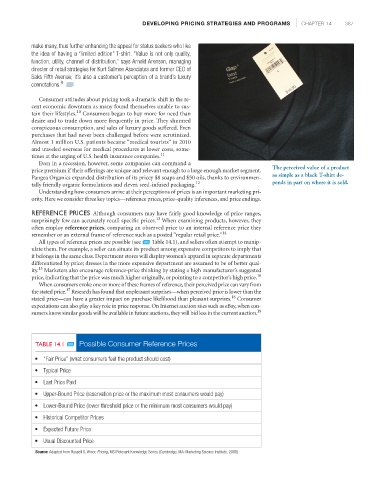
                                                                                         The perceived value of a product
           price premium if their offerings are unique and relevant enough to a large enough market segment.
           Pangea Organics expanded distribution of its pricey $8 soaps and $50 oils, thanks to environmen-  as simple as a black T-shirt de-
           tally friendly organic formulations and clever, seed-infused packaging. 12    pends in part on where it is sold.
              Understanding how consumers arrive at their perceptions of prices is an important marketing pri-
           ority.Here we consider three key topics—reference prices,price–quality inferences,and price endings.

           REFERENCE PRICES Although consumers may have fairly good knowledge of price ranges,
           surprisingly few can accurately recall specific prices. 13  When examining products, however, they
           often employ reference prices, comparing an observed price to an internal reference price they
           remember or an external frame of reference such as a posted “regular retail price.” 14
              All types of reference prices are possible (see   Table 14.1), and sellers often attempt to manip-
           ulate them. For example, a seller can situate its product among expensive competitors to imply that
           it belongs in the same class. Department stores will display women’s apparel in separate departments
           differentiated by price; dresses in the more expensive department are assumed to be of better qual-
             15
           ity. Marketers also encourage reference-price thinking by stating a high manufacturer’s suggested
           price, indicating that the price was much higher originally, or pointing to a competitor’s high price. 16
              When consumers evoke one or more of these frames of reference,their perceived price can vary from
                      17
           the stated price. Research has found that unpleasant surprises—when perceived price is lower than the
                                                                            18
           stated price—can have a greater impact on purchase likelihood than pleasant surprises. Consumer
           expectations can also play a key role in price response.On Internet auction sites such as eBay,when con-
           sumers know similar goods will be available in future auctions,they will bid less in the current auction. 19


             TABLE 14.1    Possible Consumer Reference Prices

            • “Fair Price” (what consumers feel the product should cost)
            • Typical Price

            • Last Price Paid
            • Upper-Bound Price (reservation price or the maximum most consumers would pay)

            • Lower-Bound Price (lower threshold price or the minimum most consumers would pay)
            • Historical Competitor Prices
            • Expected Future Price

            • Usual Discounted Price
             Source: Adapted from Russell S. Winer, Pricing, MSI Relevant Knowledge Series (Cambridge, MA: Marketing Science Institute, 2006).

