


Page 411 - Marketing Management
P. 411
388    PART 5    SHAPING THE MARKET OFFERINGS


                                        Clever marketers try to frame the price to signal the best value possible. For example, a relatively
                                      expensive item can look less expensive if the price is broken into smaller units, such as a $500 an-
                                      nual membership for “under $50 a month,” even if the totals are the same. 20
                                      PRICE-QUALITY INFERENCES Many consumers use price as an indicator of quality. Image
                                      pricing is especially effective with ego-sensitive products such as perfumes, expensive cars, and
                                      designer clothing. A $100 bottle of perfume might contain $10 worth of scent, but gift givers pay
                                      $100 to communicate their high regard for the receiver.
                                                                          21
                                        Price and quality perceptions of cars interact. Higher-priced cars are perceived to possess high
                                      quality. Higher-quality cars are likewise perceived to be higher priced than they actually are. When
                                      information about true quality is available, price becomes a less significant indicator of quality.
                                      When this information is not available, price acts as a signal of quality.
                                        Some brands adopt exclusivity and scarcity to signify uniqueness and justify premium pricing.
                                      Luxury-goods makers of watches, jewelry, perfume, and other products often emphasize exclusivity
                                      in their communication messages and channel strategies. For luxury-goods customers who desire
                                      uniqueness, demand may actually increase price, because they then believe fewer other customers
                                      can afford the product. 22
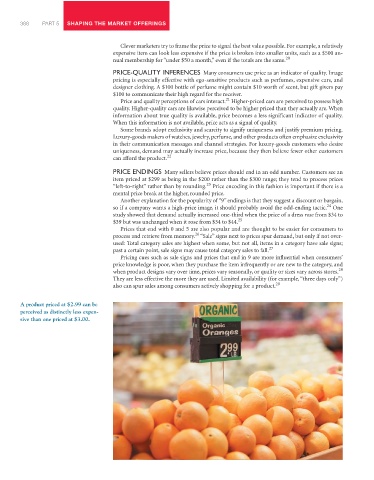
                                      PRICE ENDINGS Many sellers believe prices should end in an odd number. Customers see an
                                      item priced at $299 as being in the $200 rather than the $300 range; they tend to process prices
                                      “left-to-right” rather than by rounding. 23  Price encoding in this fashion is important if there is a
                                      mental price break at the higher, rounded price.
                                        Another explanation for the popularity of “9” endings is that they suggest a discount or bargain,
                                      so if a company wants a high-price image, it should probably avoid the odd-ending tactic. 24  One
                                      study showed that demand actually increased one-third when the price of a dress rose from $34 to
                                      $39 but was unchanged when it rose from $34 to $44. 25
                                        Prices that end with 0 and 5 are also popular and are thought to be easier for consumers to
                                                                26
                                      process and retrieve from memory. “Sale” signs next to prices spur demand, but only if not over-
                                      used: Total category sales are highest when some, but not all, items in a category have sale signs;
                                      past a certain point, sale signs may cause total category sales to fall. 27
                                        Pricing cues such as sale signs and prices that end in 9 are more influential when consumers’
                                      price knowledge is poor, when they purchase the item infrequently or are new to the category, and
                                      when product designs vary over time, prices vary seasonally, or quality or sizes vary across stores. 28
                                      They are less effective the more they are used. Limited availability (for example, “three days only”)
                                      also can spur sales among consumers actively shopping for a product. 29


        A product priced at $2.99 can be
        perceived as distinctly less expen-
        sive than one priced at $3.00.

