


Page 408 - Marketing Management
P. 408
DEVELOPING PRICING STRATEGIES AND PROGRAMS | CHAPTER 14           385


               Chris Anderson, editor-in-chief of Wired, strongly believes that in a  Other strategies cut costs or generate outside revenue:
           digital marketplace, companies can make money with “free” products.As  4.  Seats don’t recline, window shades and seat-back pockets have
           evidence, he offers revenue models involving cross-subsidies (giving  been removed, and there is no entertainment. Seat-back trays
           away a DVR to sell cable service) and freemiums (offering the Flickr on-  now carry ads, and the exteriors of the planes are giant
           line photo management and sharing application for free to everyone  revenue-producing billboards for Vodafone Group, Jaguar, Hertz,
           while selling the superior FlickrPro to more highly involved users).  and others.
               Some online firms have successfully moved “from free to fee” and
           begun charging for services. Under a new participative pricing mecha-  5.  More than 99 percent of tickets are sold online. The Web site also
                                                                     offers travel insurance, hotels, ski packages, and car rentals.
           nism that lets consumers decide the price they feel is warranted, buyers
           often choose to pay more than zero and even enough that the seller’s  6.  Only Boeing 737–800 jets are flown to reduce maintenance, and
           revenues increase over what a fixed price would have yielded.  flight crews buy their own uniforms.
               Offline, profits for discount air carrier Ryanair have been sky-high  The formula works for Ryanair’s customers; the airline flies 58 mil-
           thanks to its revolutionary business model. The secret? Founder  lion of them to over 150 airports each year. All the extras add up to
           Michael O’Leary thinks like a retailer, charging for almost everything  20 percent of revenue. Ryanair enjoys net margins of 25 percent, more
           but the seat itself:                                  than three times Southwest’s 7 percent. Some industry pundits even re-
           1.  A quarter of Ryanair’s seats are free. O’Leary wants to double that  fer to Ryanair as “Walmart with wings!” European discount carrier
               within five years, with the ultimate goal of making all seats free.  easyJet has adopted many of the same practices.
               Passengers currently pay only taxes and fees of about $10 to $24,
                                                                 Sources: Chris Anderson, Free: The Future of a Radical Price (New York:
               with an average one-way fare of roughly $52.      Hyperion, 2009); Peter J. Howe, “The Next Pinch: Fees to Check Bags,” Boston
                                                                 Globe, March 8, 2007; Katherine Heires, “Why It Pays to Give Away the Store,”
           2.  Passengers pay extra for everything else: for checked luggage
                                                                 Business 2.0 (October 2006): 36–37; Kerry Capel, “‘Wal-Mart with Wings,’”
               ($9.50 per bag), snacks ($5.50 for a hot dog, $4.50 for chicken  BusinessWeek, November 27, 2006, pp. 44–45; Matthew Maier, “A Radical Fix for
               soup, $3.50 for water), and bus or train transportation into town  Airlines: Make Flying Free,” Business 2.0 (April 2006): 32–34; Ju-Young Kim,
                                                                 Martin Natter, and Martin Spann, “Pay What You Want: A New Participative
               from the far-flung airports Ryanair uses ($24).
                                                                 Pricing Mechanism,” Journal of Marketing 73 (January 2009), pp. 44–58; Koen
           3.  Flight attendants sell a variety of merchandise, including digital cam-  Pauwels and Allen Weiss, “Moving from Free to Fee: How Online Firms Market to
                                                                 Change Their Business Model Successfully,” Journal of Marketing 72 (May 2008),
               eras ($137.50) and iPocket MP3 players ($165). Onboard gambling
                                                                 pp. 14–31; Bruce Myerson, “Skype Takes Its Show on the Road,” BusinessWeek,
               and cell phone service are projected new revenue sources.  October 29, 2007, p. 38.

              Sellers can:

           •   Monitor customer behavior and tailor offers to individuals. GE Lighting, which gets 55,000
               pricing requests a year, has Web programs that evaluate 300 factors that go into a pricing
               quote, such as past sales data and discounts, so it can reduce processing time from up to
               30 days to 6 hours.


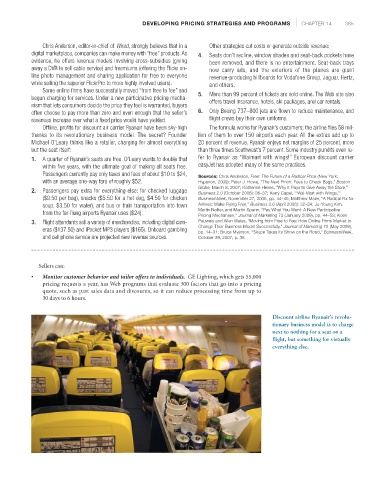
                                                                                         Discount airline Ryanair’s revolu-
                                                                                         tionary business model is to charge
                                                                                         next to nothing for a seat on a
                                                                                         flight, but something for virtually
                                                                                         everything else.

