


Page 173 - Materials Science and Engineering An Introduction
P. 173
5.4 Fick’s Second Law—Nonsteady-State Diffusion  •  145

                        EXAMPLE PROBLEM 5.1

                          Diffusion Flux Computation
                          A plate of iron is exposed to a carburizing (carbon-rich) atmosphere on one side and a decar-
                          burizing (carbon-deficient) atmosphere on the other side at 700 C (1300 F). If a condition of
                          steady state is achieved, calculate the diffusion flux of carbon through the plate if the concen-
                                                                        3
                                                                                2
                          trations of carbon at positions of 5 and 10 mm (5   10  and 10  m) beneath the carburizing
                                                                                                    2
                                                 3
                          surface are 1.2 and 0.8 kg/m , respectively. Assume a diffusion coefficient of 3   10  11  m /s at
                          this temperature.
                          Solution
                          Fick’s first law, Equation 5.2, is used to determine the diffusion flux. Substitution of the values
                          just given into this expression yields

                                                                          (1.2 - 0.8) kg/m 3
                                               C A - C B         -11  2
                                         J = -D        = -(3 * 10    m /s)     -3     -2
                                               x A - x B                 (5 * 10  - 10 ) m
                                                         2
                                                  -9
                                          = 2.4 * 10  kg/m # s
              5.4   FICK’S SECOND LAW—NONSTEADY-STATE
                    DIFFUSION
                                 Most practical diffusion situations are nonsteady-state ones—that is, the diffusion flux
                                 and the concentration gradient at some particular point in a solid vary with time, with
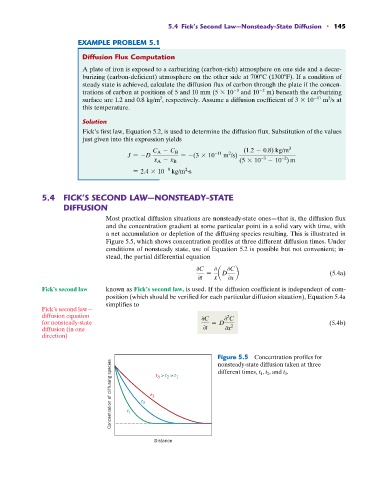
                                 a net accumulation or depletion of the diffusing species resulting. This is illustrated in
                                 Figure 5.5, which shows concentration profiles at three different diffusion times. Under
                                 conditions of nonsteady state, use of Equation 5.2 is possible but not convenient; in-
                                 stead, the partial differential equation

                                                            0C   0   0C
                                                               =   aD   b                           (5.4a)
                                                            0t   x    0x
              Fick’s second law  known as Fick’s second law, is used. If the diffusion coefficient is independent of com-
                                 position (which should be verified for each particular diffusion situation), Equation 5.4a
                                 simplifies to
              Fick’s second law—
              diffusion equation                                     2
              for nonsteady-state                             0C  = D 0 C                           (5.4b)
              diffusion (in one                               0t     0x 2
              direction)


                                                                  Figure 5.5  Concentration profiles for
                                  Concentration of diffusing species  t 1  t 2  t 3  3    2    1
                                                                  nonsteady-state diffusion taken at three
                                                                  different times, t 1 , t 2 , and t 3 .
                                                t > t > t


                                               Distance

