


Page 244 - Materials Science and Engineering An Introduction
P. 244
C h a p t e r 7    Dislocations and

                                  Strengthening Mechanisms


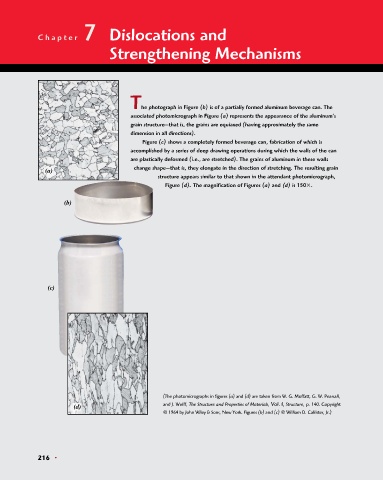
                                        The photograph in Figure (b) is of a partially formed aluminum beverage can. The
                                        associated photomicrograph in Figure (a) represents the appearance of the aluminum’s
                                        grain structure—that is, the grains are equiaxed (having approximately the same
                                          dimension in all directions).
                                            Figure (c) shows a completely formed beverage can, fabrication of which is
                                          accomplished by a series of deep drawing operations during which the walls of the can
                                        are plastically deformed (i.e., are stretched). The grains of aluminum in these walls
                                         change shape—that is, they elongate in the direction of stretching. The resulting grain
              (a)
                                                structure appears similar to that shown in the attendant photomicrograph,
                                                   Figure (d). The magnification of Figures (a) and (d) is 150 .


                    (b)


               (c)


                                                  (The photo micrographs in figures (a) and (d) are taken from W. G. Moffatt, G. W. Pearsall,
                                                  and J. Wulff, The Structure and Properties of Materials, Vol. I, Structure, p. 140. Copyright
                       (d)
                                                  © 1964 by John Wiley & Sons, New York. Figures (b) and (c) © William D. Callister, Jr.)


            216  •

