


Page 379 - Materials Science and Engineering An Introduction
P. 379
Questions and Problems  •  351

                 gion. If the mass fraction of each phase is 0.5,   The following table gives the approximate densi-
                 then estimate                                  ties of the various metals at the alloy temperatures:
                 (a)  the temperature of the alloy
                                                                                                       3
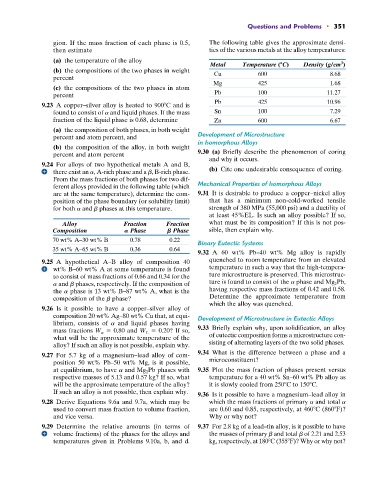
                                                                Metal     Temperature ( C)  Density (g/cm )
                 (b)  the compositions of the two phases in weight   Cu        600                  8.68
                 percent
                                                                 Mg            425                  1.68
                 (c) the compositions of the two phases in atom
                 percent                                         Pb            100                 11.27
                                                                 Pb            425                 10.96
              9.23  A copper–silver alloy is heated to 900 C and is
                 found to consist of a and liquid phases. If the mass   Sn     100                  7.29
                 fraction of the liquid phase is 0.68, determine  Zn           600                  6.67
                 (a)  the composition of both phases, in both weight
                 percent and atom percent, and              Development of Microstructure
                                                            in Isomorphous Alloys
                 (b)  the composition of the alloy, in both weight
                 percent and atom percent                   9.30  (a)  Briefly describe the phenomenon of coring
                                                                and why it occurs.
              9.24  For alloys of two hypothetical metals A and B,
                 there exist an a, A-rich phase and a b, B-rich phase.   (b)  Cite one undesirable consequence of coring.
                 From the mass fractions of both phases for two dif-
                 ferent alloys provided in the following table (which   Mechanical Properties of Isomorphous Alloys
                 are at the same temperature), determine the com-  9.31  It is desirable to produce a copper–nickel alloy
                 position of the phase boundary (or solubility limit)   that has a minimum non-cold-worked tensile
                 for both a and b phases at this temperature.   strength of 380 MPa (55,000 psi) and a ductility of
                                                                at least 45%EL. Is such an alloy possible? If so,
                    Alloy             Fraction     Fraction     what must be its composition? If this is not pos-
                 Composition          A Phase      B Phase      sible, then explain why.
                 70 wt% A–30 wt% B      0.78        0.22    Binary Eutectic Systems
                 35 wt% A–65 wt% B      0.36        0.64
                                                            9.32  A 60 wt% Pb–40 wt% Mg alloy is rapidly
              9.25  A hypothetical A–B alloy of composition 40  quenched to room temperature from an elevated
                 wt% B–60 wt% A at some temperature is found    temperature in such a way that the high-tempera-
                 to consist of mass fractions of 0.66 and 0.34 for the   ture microstructure is preserved. This microstruc-
                 a and b phases, respectively. If the composition of   ture is found to consist of the a phase and Mg 2 Pb,
                 the a phase is 13 wt% B–87 wt% A, what is the   having respective mass fractions of 0.42 and 0.58.
                 composition of the b phase?                    Determine the approximate temperature from
                                                                which the alloy was quenched.
              9.26  Is it possible to have a copper–silver alloy of
                 composition 20 wt% Ag–80 wt% Cu that, at equi-  Development of Microstructure in Eutectic Alloys
                 librium, consists of a  and liquid phases having  Briefly explain why, upon solidification, an alloy
                 mass fractions W a     0.80 and W L     0.20? If so,  9.33
                 what will be the approximate temperature of the   of eutectic composition forms a microstructure con-
                 alloy? If such an alloy is not possible, explain why.  sisting of alternating layers of the two solid phases.
              9.27  For 5.7 kg of a magnesium–lead alloy of com-  9.34  What is the difference between a phase and a
                 position 50 wt% Pb–50 wt% Mg, is it possible,  microconstituent?
                 at equilibrium, to have a and Mg 2 Pb phases with   9.35  Plot the mass fraction of phases present versus
                 respective masses of 5.13 and 0.57 kg? If so, what   temperature for a 40 wt% Sn–60 wt% Pb alloy as
                 will be the approximate temperature of the alloy?   it is slowly cooled from 250 C to 150 C.
                 If such an alloy is not possible, then explain why.  9.36  Is it possible to have a magnesium–lead alloy in
              9.28  Derive Equations 9.6a and 9.7a, which may be  which the mass fractions of primary a and total a
                 used to convert mass fraction to volume fraction,   are 0.60 and 0.85, respectively, at 460 C (860 F)?
                 and vice versa.                                Why or why not?

              9.29  Determine the relative amounts (in terms of  9.37  For 2.8 kg of a lead–tin alloy, is it possible to have
                 volume fractions) of the phases for the alloys and   the masses of primary b and total b of 2.21 and 2.53
                 temperatures given in Problems 9.10a, b, and d.  kg, respectively, at 180 C (355 F)? Why or why not?

