


Page 381 - Materials Science and Engineering An Introduction
P. 381
Questions and Problems  •  353


                                                              1100
               1000
                                                              1000                                L

                                                                                        1
                800                                           900
                                                                                            	 1
                                   L
               Temperature (°C)  600                          Temperature (°C)  800


                                                              700
                400                                                                       2     	 2
                                                              600

                                                                                                   1   1
                                                                                                        2
                                                              500                                     2
                200

                  0      20      40     60      80     100    400
                 (Sn)           Composition (wt% Au)    (Au)
                                                                0     4    8    12   16    20   24   28
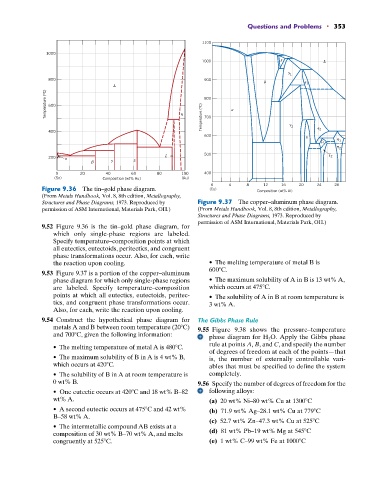
              Figure 9.36  The tin–gold phase diagram.          (Cu)          Composition (wt% Al)
              (From Metals Handbook, Vol. 8, 8th edition, Metallography,
              Structures and Phase Diagrams, 1973. Reproduced by   Figure 9.37  The copper–aluminum phase diagram.
              permission of ASM International, Materials Park, OH.)  (From Metals Handbook, Vol. 8, 8th edition, Metallography,
                                                            Structures and Phase Diagrams, 1973. Reproduced by
                                                            permission of ASM International, Materials Park, OH.)
              9.52  Figure 9.36 is the tin–gold phase diagram, for
                 which only single-phase regions are labeled.
                 Specify temperature–composition points at which
                 all eutectics, eutectoids, peritectics, and congruent
                 phase transformations occur. Also, for each, write
                 the reaction upon cooling.                     •  The melting temperature of metal B is
                                                                600 C.
              9.53  Figure 9.37 is a portion of the copper–aluminum
                 phase diagram for which only single-phase regions      •  The maximum solubility of A in B is 13 wt% A,
                 are labeled. Specify temperature–composition   which occurs at 475 C.
                 points at which all eutectics, eutectoids, peritec-     •  The solubility of A in B at room temperature is
                 tics, and congruent phase transformations occur.  3 wt% A.
                 Also, for each, write the reaction upon cooling.

              9.54  Construct the hypothetical phase diagram for  The Gibbs Phase Rule
                 metals A and B between room temperature (20 C)   Figure 9.38 shows the pressure–temperature
                 and 700 C, given the following information:  9.55 phase diagram for H 2 O. Apply the Gibbs phase
                 •  The melting temperature of metal A is 480 C.  rule at points A, B, and C, and specify the number
                                                                of degrees of freedom at each of the points—that
                 •  The maximum solubility of B in A is 4 wt% B,   is, the number of externally controllable vari-
                 which occurs at 420 C.                         ables that must be specified to define the system
                 •  The solubility of B in A at room temperature is   completely.
                 0 wt% B.                                   9.56  Specify the number of degrees of freedom for the
                 •  One eutectic occurs at 420 C and 18 wt% B–82   following alloys:
                 wt% A.                                         (a)  20 wt% Ni–80 wt% Cu at 1300 C
                 •  A second eutectic occurs at 475 C and 42 wt%   (b)  71.9 wt% Ag–28.1 wt% Cu at 779 C
                 B–58 wt% A.
                                                                (c)  52.7 wt% Zn–47.3 wt% Cu at 525 C
                 •  The intermetallic compound AB exists at a
                 composition of 30 wt% B–70 wt% A, and melts    (d)  81 wt% Pb–19 wt% Mg at 545 C
                 congruently at 525 C.                          (e)  1 wt% C–99 wt% Fe at 1000 C

