


Page 388 - Materials Science and Engineering An Introduction
P. 388
360   •  Chapter 10  /  Phase Transformations

                                sum of both terms (Figure 10.2b) first increases, passes through a maximum, and finally
                                decreases. In a physical sense, this means that as a solid particle begins to form as atoms
                                in the liquid cluster together, its free energy first increases. If this cluster reaches a size
                                corresponding to the critical radius r*, then growth will continue with the accompani-
                                ment of a decrease in free energy. However, a cluster of radius less than the critical
                                value will shrink and redissolve. This subcritical particle is an embryo, and the particle
                                of radius greater than r* is termed a nucleus. A critical free energy,  G*, occurs at the
                                critical radius and, consequently, at the maximum of the curve in Figure 10.2b. This
                                 G* corresponds to an activation free energy, which is the free energy required for the
                                formation of a stable nucleus. Equivalently, it may be considered an energy barrier to
                                the nucleation process.
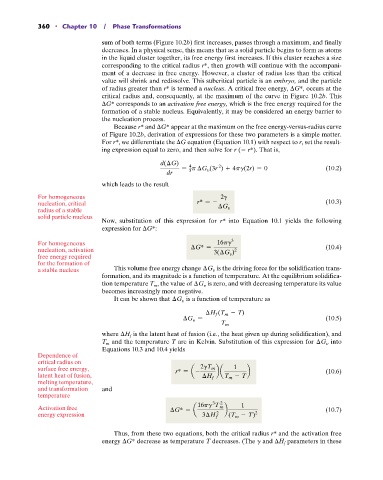
                                   Because r* and  G* appear at the maximum on the free energy-versus-radius curve
                                of Figure 10.2b, derivation of expressions for these two parameters is a simple matter.
                                For r*, we differentiate the  G equation (Equation 10.1) with respect to r, set the result-
                                ing expression equal to zero, and then solve for r (  r*). That is,

                                                 d( G)
                                                        = p  G y (3r ) + 4pg(2r) = 0               (10.2)
                                                          4
                                                                   2
                                                   dr     3
                                which leads to the result
            For homogeneous                                        2g
            nucleation, critical                            r*= -                                  (10.3)
            radius of a stable                                      G y
            solid particle nucleus
                                Now, substitution of this expression for r*  into Equation 10.1 yields the following
                                 expression for  G*:

            For homogeneous                                       16pg 3                           (10.4)
            nucleation, activation                         G*=   3( G y ) 2
            free energy required
            for the formation of
            a stable nucleus       This volume free energy change  G y  is the driving force for the solidification trans-
                                formation, and its magnitude is a function of temperature. At the equilibrium solidifica-
                                tion temperature T m , the value of  G y  is zero, and with decreasing temperature its value
                                becomes increasingly more negative.
                                   It can be shown that  G y  is a function of temperature as

                                                                H f (T m - T)
                                                         G y =                                     (10.5)
                                                                   T m
                                where  H f  is the latent heat of fusion (i.e., the heat given up during solidification), and
                                T m  and the temperature T are in Kelvin. Substitution of this expression for   G y  into
                                Equations 10.3 and 10.4 yields
            Dependence of
            critical radius on
            surface free energy,                      r*= a -  2gT m b a  1  b                     (10.6)
            latent heat of fusion,                             H f  T m - T
            melting temperature,
            and transformation   and
            temperature
                                                                 3  2
            Activation free                          G*= a  16pg T m  b  1                         (10.7)
            energy expression                                 3 H f 2  (T m - T) 2

                                   Thus, from these two equations, both the critical radius r* and the activation free
                                energy  G* decrease as temperature T decreases. (The g and  H f  parameters in these

