


Page 227 - Materials Chemistry, Second Edition
P. 227
214                                                         3 Metals


             Among the refractory metals, perhaps none are as widely exploited for commer-
           cial applications as titanium. From golf clubs to shavers, titanium is now pervasive
           throughout our modern world. Although some of the proposed applications may be
           suitably classified as “hype,” the broad appeal for titanium alloys is due to its
           favorable properties such as high strength/weight ratio and superior corrosion
           resistance. Titanium is also readily available from a number of mineral sources; it
           is the sixth most abundant metal, behind Al, Fe, Cu, Zn, and Mg.
             As you will note from Table 3.6, the density of titanium is significantly less than
           the other refractories (midway between aluminum and iron); even so, the yield
           strength ranges up to 1,800 MPa. To put this in perspective, this strength is of the
           same magnitude as Ni-doped ultrahigh strength stainless steels – at a fraction of
           the weight. The low density of Ti (and other metals such as Be and Mg) is due to the
           hexagonal close-packed crystal structure, which is much less dense than bcc or fcc
           arrays (as discussed in Chapter 2).


           Shape-memory alloys
           As their name implies, shape-memory alloys are able to revert back to their original
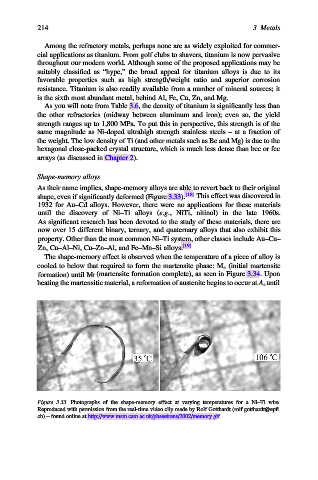
           shape, even if significantly deformed (Figure 3.33). [18]  This effect was discovered in
           1932 for Au–Cd alloys. However, there were no applications for these materials
           until the discovery of Ni–Ti alloys (e.g., NiTi, nitinol) in the late 1960s.
           As significant research has been devoted to the study of these materials, there are
           now over 15 different binary, ternary, and quaternary alloys that also exhibit this
           property. Other than the most common Ni–Ti system, other classes include Au–Cu–
           Zn, Cu–Al–Ni, Cu–Zn–Al, and Fe–Mn–Si alloys. [19]
             The shape-memory effect is observed when the temperature of a piece of alloy is
           cooled to below that required to form the martensite phase: M s (initial martensite
           formation) until M f (martensite formation complete), as seen in Figure 3.34. Upon
           heating the martensitic material, a reformation of austenite begins to occur at A s until


           Figure 3.33. Photographs of the shape-memory effect at varying temperatures for a Ni–Ti wire.
           Reproduced with permission from the real-time video clip made by Rolf Gotthardt (rolf.gotthardt@epfl.
           ch) – found online at http://www.msm.cam.ac.uk/phasetrans/2002/memory.gif.

