


Page 229 - Materials Chemistry, Second Edition
P. 229
216                                                         3 Metals


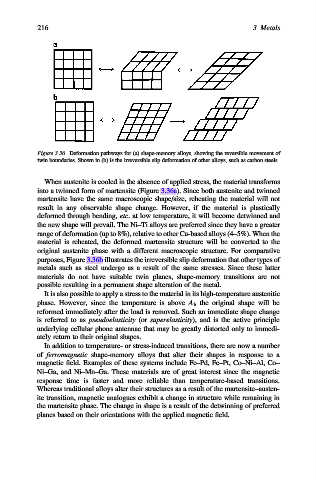
           Figure 3.36. Deformation pathways for (a) shape-memory alloys, showing the reversible movement of
           twin boundaries. Shown in (b) is the irreversible slip deformation of other alloys, such as carbon steels.

             When austenite is cooled in the absence of applied stress, the material transforms
           into a twinned form of martensite (Figure 3.36a). Since both austenite and twinned
           martensite have the same macroscopic shape/size, reheating the material will not
           result in any observable shape change. However, if the material is plastically
           deformed through bending, etc. at low temperature, it will become detwinned and
           the new shape will prevail. The Ni–Ti alloys are preferred since they have a greater
           range of deformation (up to 8%), relative to other Cu-based alloys (4–5%). When the
           material is reheated, the deformed martensite structure will be converted to the
           original austenite phase with a different macroscopic structure. For comparative
           purposes, Figure 3.36b illustrates the irreversible slip deformation that other types of
           metals such as steel undergo as a result of the same stresses. Since these latter
           materials do not have suitable twin planes, shape-memory transitions are not
           possible resulting in a permanent shape alteration of the metal.
             It is also possible to apply a stress to the material in its high-temperature austenitic
           phase. However, since the temperature is above A f , the original shape will be
           reformed immediately after the load is removed. Such an immediate shape change
           is referred to as pseudoelasticity (or superelasticity), and is the active principle
           underlying cellular phone antennae that may be greatly distorted only to immedi-
           ately return to their original shapes.
             In addition to temperature- or stress-induced transitions, there are now a number
           of ferromagnetic shape-memory alloys that alter their shapes in response to a
           magnetic field. Examples of these systems include Fe–Pd, Fe–Pt, Co–Ni–Al, Co–
           Ni–Ga, and Ni–Mn–Ga. These materials are of great interest since the magnetic
           response time is faster and more reliable than temperature-based transitions.
           Whereas traditional alloys alter their structures as a result of the martensite–austen-
           ite transition, magnetic analogues exhibit a change in structure while remaining in
           the martensite phase. The change in shape is a result of the detwinning of preferred
           planes based on their orientations with the applied magnetic field.

