


Page 228 - Materials Chemistry, Second Edition
P. 228
215
            3.2. Metallic Structures and Properties


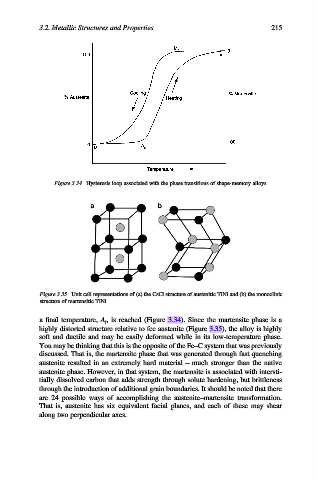
                Figure 3.34. Hysteresis loop associated with the phase transitions of shape-memory alloys.


            Figure 3.35. Unit cell representations of (a) the CsCl structure of austenitic TiNi and (b) the monoclinic
            structure of martensitic TiNi.

            a final temperature, A f , is reached (Figure 3.34). Since the martensite phase is a
            highly distorted structure relative to fcc austenite (Figure 3.35), the alloy is highly
            soft and ductile and may be easily deformed while in its low-temperature phase.
            You may be thinking that this is the opposite of the Fe–C system that was previously
            discussed. That is, the martensite phase that was generated through fast quenching
            austenite resulted in an extremely hard material – much stronger than the native
            austenite phase. However, in that system, the martensite is associated with intersti-
            tially dissolved carbon that adds strength through solute hardening, but brittleness
            through the introduction of additional grain boundaries. It should be noted that there
            are 24 possible ways of accomplishing the austenite–martensite transformation.
            That is, austenite has six equivalent facial planes, and each of these may shear
            along two perpendicular axes.

