


Page 249 - Materials Chemistry, Second Edition
P. 249
236                                                         3 Metals


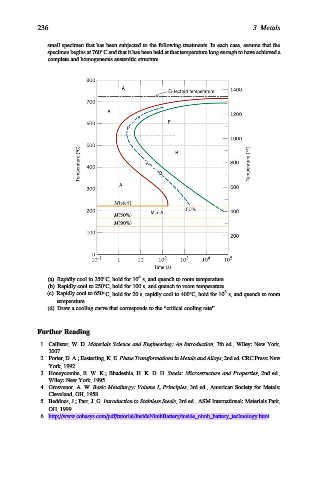
              small specimen that has been subjected to the following treatments. In each case, assume that the
              specimen begins at 760 C and that it has been held at that temperature long enough to have achieved a

              complete and homogeneous austenitic structure.


                                       4
              (a) Rapidly cool to 350 C, hold for 10 s, and quench to room temperature.

              (b) Rapidly cool to 250 C, hold for 100 s, and quench to room temperature.

                                                               3


              (c) Rapidly cool to 650 C, hold for 20 s, rapidly cool to 400 C, hold for 10 s, and quench to room
                 temperature.
              (d) Draw a cooling curve that corresponds to the “critical cooling rate”.
           Further Reading
            1. Callister, W. D. Materials Science and Engineering: An Introduction, 7th ed., Wiley: New York,
              2007.
            2. Porter, D. A.; Easterling, K. E. Phase Transformations in Metals and Alloys, 2nd ed. CRC Press: New
              York, 1992.
            3. Honeycombe, R. W. K.; Bhadeshia, H. K. D. H. Steels: Microstructure and Properties, 2nd ed.,
              Wiley: New York, 1995.
            4. Grosvenor, A. W. Basic Metallurgy: Volume I, Principles, 3rd ed., American Society for Metals:
              Cleveland, OH, 1958.
            5. Beddoes, J.; Parr, J. G. Introduction to Stainless Steels, 3rd ed., ASM International: Materials Park,
              OH, 1999.
            6. http://www.cobasys.com/pdf/tutorial/InsideNimhBattery/inside_nimh_battery_technology.html

