


Page 245 - Materials Chemistry, Second Edition
P. 245
232                                                         3 Metals


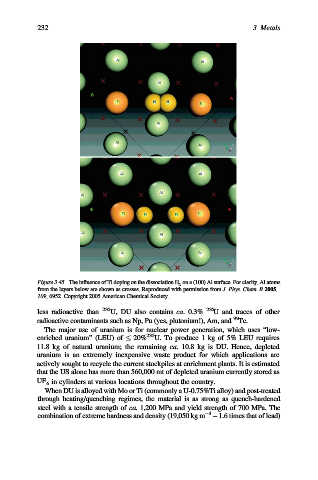
           Figure 3.45. The influence of Ti doping on the dissociation H 2 on a (100) Al surface. For clarity, Al atoms
           from the layers below are shown as crosses. Reproduced with permission from J. Phys. Chem. B 2005,
           109, 6952. Copyright 2005 American Chemical Society.
                             235                          235
           less radioactive than  U, DU also contains ca.0.3%  U and traces of other
                                                                 99
           radioactive contaminants such as Np, Pu (yes, plutonium!), Am, and Tc.
             The major use of uranium is for nuclear power generation, which uses “low-
           enriched uranium” (LEU) of   20% 235 U. To produce 1 kg of 5% LEU requires
           11.8 kg of natural uranium; the remaining ca. 10.8 kg is DU. Hence, depleted
           uranium is an extremely inexpensive waste product for which applications are
           actively sought to recycle the current stockpiles at enrichment plants. It is estimated
           that the US alone has more than 560,000 mt of depleted uranium currently stored as
           UF 6 in cylinders at various locations throughout the country.
             When DU is alloyed with Mo or Ti (commonly a U-0.75%Ti alloy) and post-treated
           through heating/quenching regimes, the material is as strong as quench-hardened
           steel with a tensile strength of ca. 1,200 MPa and yield strength of 700 MPa. The
           combination of extreme hardness and density (19,050 kg m  3  – 1.6 times that of lead)

