


Page 246 - Materials Chemistry, Second Edition
P. 246
233
            References

            makes DU very effective at piercing armor. This has resulted in military applications
            such as kinetic energy penetrators and protective armor. In fact, it has been reported
            that the US fired a total of 320 t of DU projectiles during the Gulf War.
              Even though the density of DU is essentially identical to W (19.0 and 17.0,
            respectively), its destructive force is much greater at a fraction of the cost. On
            impact with an armored target, the head of the projectile fractures in such a way that
            it self-sharpens. The heat released from its impact causes a disintegration of the
            surface resulting in the formation of pyrophoric dust, furthering its destructive
            ability. By comparison, tungsten penetrators are nonpyrophoric, and form a dull
            mushroom shape as they penetrate a hard target. Interestingly, within the first 10% or
                                                                  1
            so of penetration depth, with an impact velocity of >ca. 1,400 m.s , the penetrator
            and target materials both flow as if they were liquids, referred to as hydrodynamic
            flow. As a result, the hardness and strength of the penetrator is not important; in
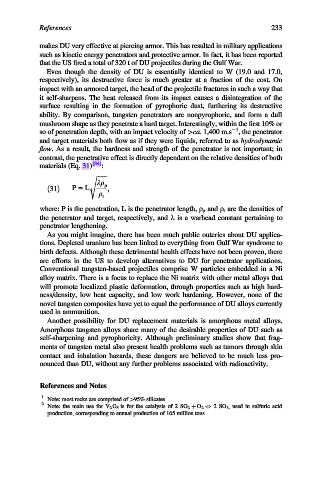
            contrast, the penetrative effect is directly dependent on the relative densities of both
            materials (Eq. 31) [34] :

                         s
                           ffiffiffiffiffiffiffi
                           lr p
              ð31Þ   P=L      ;
                            r t
            where: P is the penetration, L is the penetrator length, r p and r t are the densities of
            the penetrator and target, respectively, and l is a warhead constant pertaining to
            penetrator lengthening.
              As you might imagine, there has been much public outcries about DU applica-
            tions. Depleted uranium has been linked to everything from Gulf War syndrome to
            birth defects. Although these detrimental health effects have not been proven, there
            are efforts in the US to develop alternatives to DU for penetrator applications.
            Conventional tungsten-based projectiles comprise W particles embedded in a Ni
            alloy matrix. There is a focus to replace the Ni matrix with other metal alloys that
            will promote localized plastic deformation, through properties such as high hard-
            ness/density, low heat capacity, and low work hardening. However, none of the
            novel tungsten composites have yet to equal the performance of DU alloys currently
            used in ammunition.
              Another possibility for DU replacement materials is amorphous metal alloys.
            Amorphous tungsten alloys share many of the desirable properties of DU such as
            self-sharpening and pyrophoricity. Although preliminary studies show that frag-
            ments of tungsten metal also present health problems such as tumors through skin
            contact and inhalation hazards, these dangers are believed to be much less pro-
            nounced than DU, without any further problems associated with radioactivity.

            References and Notes

            1
              Note: most rocks are comprised of >95% silicates.
            2
              Note: the main use for V 2 O 5 is for the catalysis of 2 SO 2 þ O 2 , 2SO 3 , used in sulfuric acid
              production, corresponding to annual production of 165 million tons.

