


Page 242 - Materials Chemistry, Second Edition
P. 242
229
            3.5. Reversible Hydrogen Storage

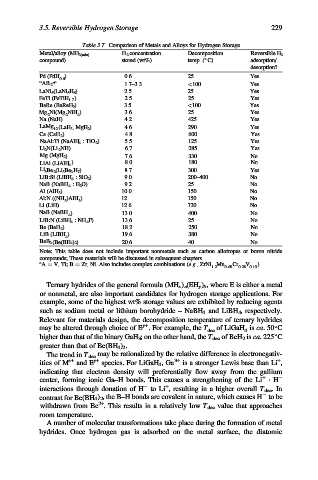
                        Table 3.7. Comparison of Metals and Alloys for Hydrogen Storage
            Metal/alloy (MH 2(ads)  H 2 concentration  Decomposition  Reversible H 2
            compound)             stored (wt%)       temp. ( C)       adsorption/

                                                                      desorption?
            Pd (PdH 0.6 )          0.6               25               Yes
            “AB 2 ” a              1.7–3.3           <100             Yes
            LaNi 5 (LaNi 5 H 6 )   2.5               25               Yes
            FeTi (FeTiH 1.7 )      2.5               25               Yes
            BaRe (BaReH 9 )        3.5               <100             Yes
            Mg 2 Ni(Mg 2 NiH 4 )   3.6               25               Yes
            Na (NaH)               4.2               425              Yes
            LaMg 12 (LaH 3 , MgH 2 )  4.6            290              Yes
            Ca (CaH 2 )            4.8               600              Yes
            NaAl:Ti (NaAlH 4 : TiO 2 )  5.5          125              Yes
            Li 2 N(Li 2 NH)        6.7               285              Yes
            Mg (MgH 2 )            7.6               330              No
            LiAl (LiAlH 4 )        8.0               180              No
            Li 3 Be 2 (Li 3 Be 2 H 7 )  8.7          300              Yes
            LiB:Si (LiBH 4 : SiO 2 )  9.0            200–400          No
            NaB (NaBH 4 :H 2 O)    9.2               25               No
            Al (AlH 3 )           10.0               150              No
            Al:N ((NH 3 )AlH 3 )  12                 150              No
            Li (LiH)              12.6               720              No
            NaB (NaBH 4 )         13.0               400              No
            LiB:N (LiBH 4 :NH 4 F)  13.6             25               No
            Be (BeH 2 )           18.2               250              No
            LiB (LiBH 4 )         19.6               380              No
            BeB 2 (Be(BH 4 ) 2 )  20.6               40               No
            Note: This table does not include important nonmetals such as carbon allotropes or boron nitride
            compounds; These materials will be discussed in subsequent chapters.
            a
            A ¼ V, Ti; B ¼ Zr, Ni. Also includes complex combinations (e.g., ZrNi 1.2 Mn 0.48 Cr 0.28 V 0.13 ).

              Ternary hydrides of the general formula (MH x ) a (EH y ) b , where E is either a metal
            or nonmetal, are also important candidates for hydrogen storage applications. For
            example, some of the highest wt% storage values are exhibited by reducing agents
            such as sodium metal or lithium borohydride – NaBH 4 and LiBH 4 , respectively.
            Relevant for materials design, the decomposition temperature of ternary hydrides
                                        y+
            may be altered through choice of E . For example, the T dec of LiGaH 4 is ca.50 C

            higher than that of the binary GaH 3 ; on the other hand, the T dec of BeH 2 is ca. 225 C

            greater than that of Be(BH 4 ) 2 .
              The trend in T dec may be rationalized by the relative difference in electronegativ-
                    x+     y+                    3+                          +
            ities of M  and E  species. For LiGaH 4 ,Ga  is a stronger Lewis base than Li ,
            indicating that electron density will preferentially flow away from the gallium
                                                                         +
            center, forming ionic Ga–H bonds. This causes a strengthening of the Li ·H
                                               +

            interactions through donation of H to Li , resulting in a higher overall T dec .In

            contrast for Be(BH 4 ) 2 , the B–H bonds are covalent in nature, which causes H to be
                            2+
            withdrawn from Be . This results in a relatively low T dec value that approaches
            room temperature.
              A number of molecular transformations take place during the formation of metal
            hydrides. Once hydrogen gas is adsorbed on the metal surface, the diatomic

