


Page 238 - Materials Chemistry, Second Edition
P. 238
225
            3.4. Magnetism


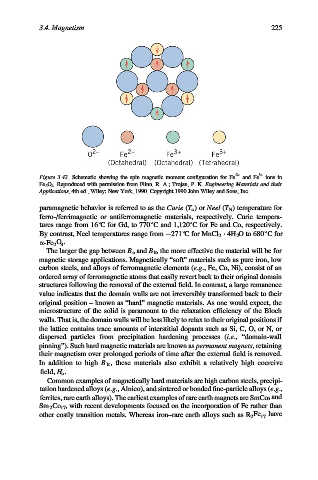
                                                                  2+    3+
            Figure 3.42. Schematic showing the spin magnetic moment configuration for Fe  and Fe  ions in
            Fe 3 O 4 . Reproduced with permission from Flinn, R. A.; Trojan, P. K. Engineering Materials and their
            Applications, 4th ed., Wiley: New York, 1990. Copyright 1990 John Wiley and Sons, Inc.

            paramagnetic behavior is referred to as the Curie (T c )or Neel (T N ) temperature for
            ferro-/ferrimagnetic or antiferromagnetic materials, respectively. Curie tempera-

            tures range from 16 C for Gd, to 770 C and 1,120 C for Fe and Co, respectively.


            By contrast, Neel temperatures range from  271 C for MnCl 2 ·4H 2 O to 680 C for

            a-Fe 2 O 3 .
              The larger the gap between B o and B R , the more effective the material will be for
            magnetic storage applications. Magnetically “soft” materials such as pure iron, low
            carbon steels, and alloys of ferromagnetic elements (e.g., Fe, Co, Ni), consist of an
            ordered array of ferromagnetic atoms that easily revert back to their original domain
            structures following the removal of the external field. In contrast, a large remanence
            value indicates that the domain walls are not irreversibly transformed back to their
            original position – known as “hard” magnetic materials. As one would expect, the
            microstructure of the solid is paramount to the relaxation efficiency of the Bloch
            walls. That is, the domain walls will be less likely to relax to their original positions if
            the lattice contains trace amounts of interstitial dopants such as Si, C, O, or N, or
            dispersed particles from precipitation hardening processes (i.e., “domain-wall
            pinning”). Such hard magnetic materials are known as permanent magnets, retaining
            their magnetism over prolonged periods of time after the external field is removed.
            In addition to high B R , these materials also exhibit a relatively high coercive
            field, H c .
              Common examples of magnetically hard materials are high carbon steels, precipi-
            tation hardened alloys (e.g., Alnico), and sintered or bonded fine-particle alloys (e.g.,
            ferrites, rare earth alloys). The earliest examples of rare earth magnets are SmCo 5 and
            Sm 2 Co 17 , with recent developments focused on the incorporation of Fe rather than
            other costly transition metals. Whereas iron–rare earth alloys such as R 2 Fe 17 have

