


Page 235 - Materials Chemistry, Second Edition
P. 235
222                                                         3 Metals


             As temperature increases, the magnetic susceptibility, w, of a paramagnetic
           substance decreases. The increasing thermal motion of atoms comprising the solid
           disrupts the ordering among neighboring magnetic dipoles. Most often, the effective
           magnetic moment, m eff , is used to describe the paramagnetic behavior, since this
           quantity is independent of both the temperature and the magnitude of the external
           field. Qualitatively, the macroscopic magnetic moment of a solid may be thought of
           as a vector summation of all the microscopic magnetic dipole moments of each atom.
             In a ferromagnetic material, the magnetic dipoles generated from unpaired
           electrons tend to align in the same direction, even in the absence of an external
           magnetic field. This phenomenon is aptly referred to as ferromagnetic coupling.
           It should be noted that ferromagnetism is the direct opposite of superconductivity,
           where all electron spins pair to form a perfectly diamagnetic material. Examples
           of ferromagnetic behavior may be observed in bulk iron, cobalt, nickel, and some
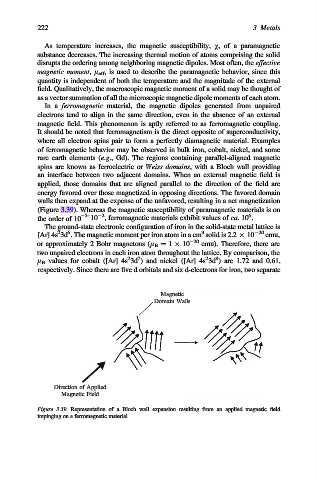
           rare earth elements (e.g., Gd). The regions containing parallel-aligned magnetic
           spins are known as ferroelectric or Weiss domains, with a Bloch wall providing
           an interface between two adjacent domains. When an external magnetic field is
           applied, those domains that are aligned parallel to the direction of the field are
           energy favored over those magnetized in opposing directions. The favored domain
           walls then expand at the expense of the unfavored, resulting in a net magnetization
           (Figure 3.39). Whereas the magnetic susceptibility of paramagnetic materials is on
                        5–   2                                       6
           the order of 10  10 , ferromagnetic materials exhibit values of ca. 10 .
             The ground-state electronic configuration of iron in the solid-state metal lattice is
                 2  6                                   3               20
           [Ar] 4s 3d . The magnetic moment per iron atom in a cm solid is 2.2   10  emu,
                                                      20
           or approximately 2 Bohr magnetons (m B ¼ 1   10  emu). Therefore, there are
           two unpaired electrons in each iron atom throughout the lattice. By comparison, the
                                                            8
                                    2
                                       7
                                                         2
           m B values for cobalt ([Ar] 4s 3d ) and nickel ([Ar] 4s 3d ) are 1.72 and 0.61,
           respectively. Since there are five d orbitals and six d-electrons for iron, two separate
                                             Magnetic
                                           Domain Walls


                Direction of Applied
                  Magnetic Field
           Figure 3.39. Representation of a Bloch wall expansion resulting from an applied magnetic field
           impinging on a ferromagnetic material.

