


Page 236 - Materials Chemistry, Second Edition
P. 236
223
            3.4. Magnetism

            d orbitals must house the unpaired electrons. In the bcc array of iron, two orbitals
            (d z2 and d x2 y2 – positioned along the cartesian axes), are not directed toward
            neighboring atoms in the lattice. [24]  Hence, these orbitals will have nonbonding
            character, and may therefore accommodate two unpaired electrons. The remaining
            four electrons within d xy ,d xz , and d yz orbitals (having lobes directed between the
            Cartesian axes) participate in metallic bonding between neighboring iron atoms,
            forming a valence band of paired electrons.
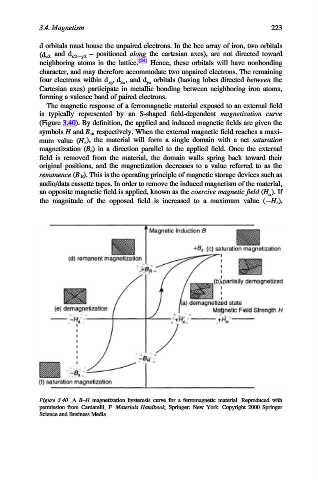
              The magnetic response of a ferromagnetic material exposed to an external field
            is typically represented by an S-shaped field-dependent magnetization curve
            (Figure 3.40). By definition, the applied and induced magnetic fields are given the
            symbols H and B o , respectively. When the external magnetic field reaches a maxi-

            mum value (H s ), the material will form a single domain with a net saturation
            magnetization (B s ) in a direction parallel to the applied field. Once the external
            field is removed from the material, the domain walls spring back toward their
            original positions, and the magnetization decreases to a value referred to as the
            remanence (B R ). This is the operating principle of magnetic storage devices such as
            audio/data cassette tapes. In order to remove the induced magnetism of the material,
            an opposite magnetic field is applied, known as the coercive magnetic field (H c ). If
            the magnitude of the opposed field is increased to a maximum value ( H s ),


            Figure 3.40. A B–H magnetization hysteresis curve for a ferromagnetic material. Reproduced with
            permission from Cardarelli, F. Materials Handbook, Springer: New York. Copyright 2000 Springer
            Science and Business Media.

