


Page 243 - Materials Chemistry, Second Edition
P. 243
230                                                         3 Metals


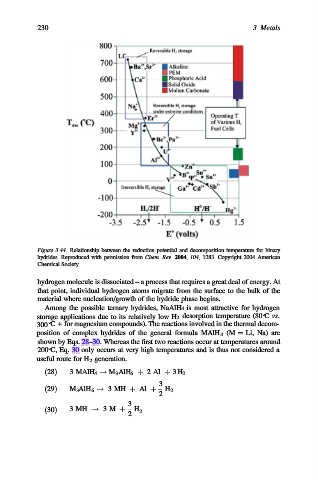
           Figure 3.44. Relationship between the reduction potential and decomposition temperature for binary
           hydrides. Reproduced with permission from Chem. Rev. 2004, 104, 1283. Copyright 2004 American
           Chemical Society.
           hydrogen molecule is dissociated – a process that requires a great deal of energy. At
           that point, individual hydrogen atoms migrate from the surface to the bulk of the
           material where nucleation/growth of the hydride phase begins.
             Among the possible ternary hydrides, NaAlH 4 is most attractive for hydrogen

           storage applications due to its relatively low H 2 desorption temperature (80 C vs.

           300 C + for magnesium compounds). The reactions involved in the thermal decom-
           position of complex hydrides of the general formula MAlH 4 (M ¼ Li, Na) are
           shown by Eqs. 28–30. Whereas the first two reactions occur at temperatures around

           200 C, Eq. 30 only occurs at very high temperatures and is thus not considered a
           useful route for H 2 generation.
             ð28Þ   3MAlH 4 ! M 3 AlH 6 þ 2Al þ 3H 2
                                             3
             ð29Þ   M 3 AlH 6 ! 3MH þ Al þ    H 2
                                             2
                                    3
             ð30Þ   3MH ! 3M þ        H 2
                                    2

