


Page 254 - Materials Chemistry, Second Edition
P. 254
241
            4.1. Properties and Types of Semiconductors


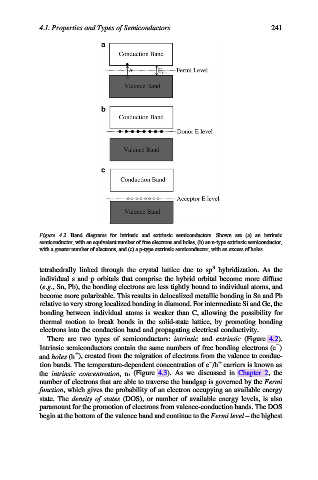
            Figure 4.2. Band diagrams for intrinsic and extrinsic semiconductors. Shown are (a) an intrinsic
            semiconductor, with an equivalent number of free electrons and holes, (b) an n-type extrinsic semiconductor,
            with a greater number of electrons, and (c) a p-type extrinsic semiconductor, with an excess of holes.

                                                           3
            tetrahedrally linked through the crystal lattice due to sp hybridization. As the
            individual s and p orbitals that comprise the hybrid orbital become more diffuse
            (e.g., Sn, Pb), the bonding electrons are less tightly bound to individual atoms, and
            become more polarizable. This results in delocalized metallic bonding in Sn and Pb
            relative to very strong localized bonding in diamond. For intermediate Si and Ge, the
            bonding between individual atoms is weaker than C, allowing the possibility for
            thermal motion to break bonds in the solid-state lattice, by promoting bonding
            electrons into the conduction band and propagating electrical conductivity.
              There are two types of semiconductors: intrinsic and extrinsic (Figure 4.2).

            Intrinsic semiconductors contain the same numbers of free bonding electrons (e )
                      +
            and holes (h ), created from the migration of electrons from the valence to conduc-
                                                             +

            tion bands. The temperature-dependent concentration of e /h carriers is known as
            the intrinsic concentration,n i (Figure 4.3). As we discussed in Chapter 2, the
            number of electrons that are able to traverse the bandgap is governed by the Fermi
            function, which gives the probability of an electron occupying an available energy
            state. The density of states (DOS), or number of available energy levels, is also
            paramount for the promotion of electrons from valence-conduction bands. The DOS
            begin at the bottom of the valence band and continue to the Fermi level – the highest

