


Page 257 - Materials Chemistry, Second Edition
P. 257
244                                                 4 Semiconductors


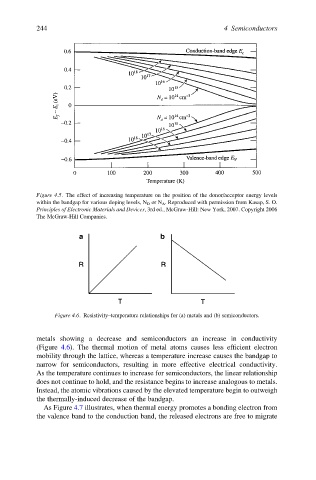
           Figure 4.5. The effect of increasing temperature on the position of the donor/acceptor energy levels
           within the bandgap for various doping levels, N D or N A . Reproduced with permission from Kasap, S. O.
           Principles of Electronic Materials and Devices, 3rd ed., McGraw-Hill: New York, 2007. Copyright 2006
           The McGraw-Hill Companies.


                Figure 4.6. Resistivity–temperature relationships for (a) metals and (b) semiconductors.


           metals showing a decrease and semiconductors an increase in conductivity
           (Figure 4.6). The thermal motion of metal atoms causes less efficient electron
           mobility through the lattice, whereas a temperature increase causes the bandgap to
           narrow for semiconductors, resulting in more effective electrical conductivity.
           As the temperature continues to increase for semiconductors, the linear relationship
           does not continue to hold, and the resistance begins to increase analogous to metals.
           Instead, the atomic vibrations caused by the elevated temperature begin to outweigh
           the thermally-induced decrease of the bandgap.
             As Figure 4.7 illustrates, when thermal energy promotes a bonding electron from
           the valence band to the conduction band, the released electrons are free to migrate

