


Page 258 - Materials Chemistry, Second Edition
P. 258
245
            4.1. Properties and Types of Semiconductors


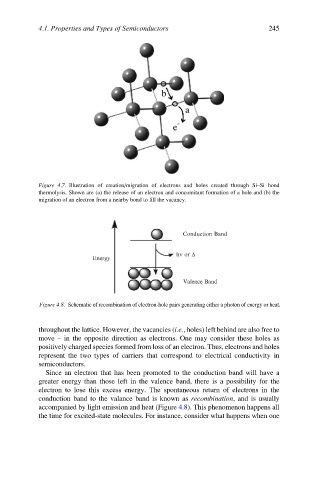
            Figure 4.7. Illustration of creation/migration of electrons and holes created through Si–Si bond
            thermolysis. Shown are (a) the release of an electron and concomitant formation of a hole and (b) the
            migration of an electron from a nearby bond to fill the vacancy.


                                                    Conduction Band


                           Energy                 hn or D


                                                    Valence Band


            Figure 4.8. Schematic of recombination of electron-hole pairs generating either a photon of energy or heat.


            throughout the lattice. However, the vacancies (i.e., holes) left behind are also free to
            move – in the opposite direction as electrons. One may consider these holes as
            positively charged species formed from loss of an electron. Thus, electrons and holes
            represent the two types of carriers that correspond to electrical conductivity in
            semiconductors.
              Since an electron that has been promoted to the conduction band will have a
            greater energy than those left in the valence band, there is a possibility for the
            electron to lose this excess energy. The spontaneous return of electrons in the
            conduction band to the valance band is known as recombination, and is usually
            accompanied by light emission and heat (Figure 4.8). This phenomenon happens all
            the time for excited-state molecules. For instance, consider what happens when one

