


Page 260 - Materials Chemistry, Second Edition
P. 260
247
            4.1. Properties and Types of Semiconductors

            minimum of the conduction band (CB) is directly above the maximum of the
            valence band (VB). Accordingly, we refer to such solids as direct bandgap materi-
            als. In contrast, for Si and Ge, the CB minimum and VB maximum are offset,
            resulting in an indirect bandgap.
                       h
              ð2Þ   l ¼
                       p
            For Si, in order for an electron at the bottom of the CB to recombine with a hole from
            the top of the VB, the momentum of the electron must shift from k cb to k vb
            (Figure 4.9b). However, this is not allowed by the Law of Conservation of Momen-
            tum. Instead, an indirect recombination mechanism must take place, wherein the
            electron is captured by an interstitial defect with energy E r , which facilitates its
            relaxation to the top of the VB. This process is accompanied by the emission of
            phonons, or lattice vibrations rather than light emission. In contrast, efficient
            electron-hole recombination may occur without any change in momentum for direct
            bandgap materials, resulting in the emission of photons. We will describe some
            important applications for direct bandgap semiconductors later in this chapter.
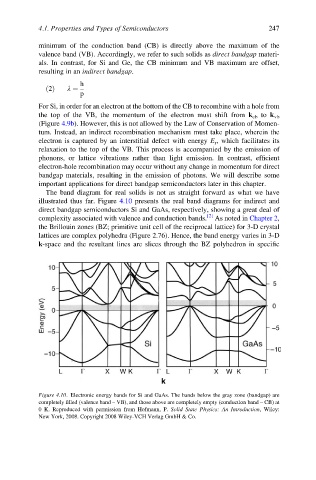
              The band diagram for real solids is not as straight forward as what we have
            illustrated thus far. Figure 4.10 presents the real band diagrams for indirect and
            direct bandgap semiconductors Si and GaAs, respectively, showing a great deal of
            complexity associated with valence and conduction bands. [2]  As noted in Chapter 2,
            the Brillouin zones (BZ; primitive unit cell of the reciprocal lattice) for 3-D crystal
            lattices are complex polyhedra (Figure 2.76). Hence, the band energy varies in 3-D
            k-space and the resultant lines are slices through the BZ polyhedron in specific


            Figure 4.10. Electronic energy bands for Si and GaAs. The bands below the gray zone (bandgap) are
            completely filled (valence band – VB), and those above are completely empty (conduction band – CB) at
            0 K. Reproduced with permission from Hofmann, P. Solid State Physics: An Introduction, Wiley:
            New York, 2008. Copyright 2008 Wiley-VCH Verlag GmbH & Co.

