


Page 265 - Materials Chemistry, Second Edition
P. 265
252                                                 4 Semiconductors


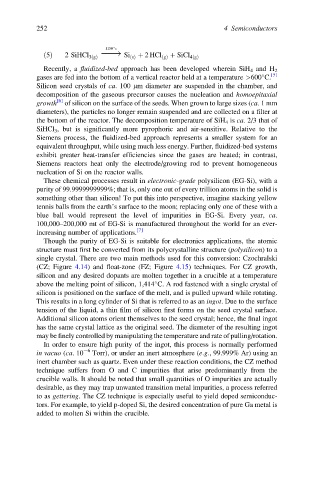
                              1150   c
             ð5Þ   2 SiHCl 3ðgÞ  ! Si ðsÞ þ 2 HCl ðgÞ þ SiCl 4ðgÞ

             Recently, a fluidized-bed approach has been developed wherein SiH 4 and H 2
                                                                            [5]

           gases are fed into the bottom of a vertical reactor held at a temperature >600 C.
           Silicon seed crystals of ca. 100 mm diameter are suspended in the chamber, and
           decomposition of the gaseous precursor causes the nucleation and homoepitaxial
                 [6]
           growth  of silicon on the surface of the seeds. When grown to large sizes (ca. 1mm
           diameters), the particles no longer remain suspended and are collected on a filter at
           the bottom of the reactor. The decomposition temperature of SiH 4 is ca. 2/3 that of
           SiHCl 3 , but is significantly more pyrophoric and air-sensitive. Relative to the
           Siemens process, the fluidized-bed approach represents a smaller system for an
           equivalent throughput, while using much less energy. Further, fluidized-bed systems
           exhibit greater heat-transfer efficiencies since the gases are heated; in contrast,
           Siemens reactors heat only the electrode/growing rod to prevent homogeneous
           nucleation of Si on the reactor walls.
             These chemical processes result in electronic-grade polysilicon (EG-Si), with a
           purity of 99.9999999999%; that is, only one out of every trillion atoms in the solid is
           something other than silicon! To put this into perspective, imagine stacking yellow
           tennis balls from the earth’s surface to the moon; replacing only one of these with a

           blue ball would represent the level of impurities in EG-Si. Every year, ca.
           100,000–200,000 mt of EG-Si is manufactured throughout the world for an ever-
           increasing number of applications. [7]
             Though the purity of EG-Si is suitable for electronics applications, the atomic
           structure must first be converted from its polycrystalline structure (polysilicon)toa
           single crystal. There are two main methods used for this conversion: Czochralski
           (CZ; Figure 4.14) and float-zone (FZ; Figure 4.15) techniques. For CZ growth,
           silicon and any desired dopants are molten together in a crucible at a temperature

           above the melting point of silicon, 1,414 C. A rod fastened with a single crystal of
           silicon is positioned on the surface of the melt, and is pulled upward while rotating.
           This results in a long cylinder of Si that is referred to as an ingot. Due to the surface
           tension of the liquid, a thin film of silicon first forms on the seed crystal surface.
           Additional silicon atoms orient themselves to the seed crystal; hence, the final ingot
           has the same crystal lattice as the original seed. The diameter of the resulting ingot
           may be finely controlled by manipulating the temperature and rate of pulling/rotation.
             In order to ensure high purity of the ingot, this process is normally performed
           in vacuo (ca.10  6  Torr), or under an inert atmosphere (e.g., 99.999% Ar) using an
           inert chamber such as quartz. Even under these reaction conditions, the CZ method
           technique suffers from O and C impurities that arise predominantly from the
           crucible walls. It should be noted that small quantities of O impurities are actually
           desirable, as they may trap unwanted transition metal impurities, a process referred
           to as gettering. The CZ technique is especially useful to yield doped semiconduc-
           tors. For example, to yield p-doped Si, the desired concentration of pure Ga metal is
           added to molten Si within the crucible.

