


Page 266 - Materials Chemistry, Second Edition
P. 266
253
            4.2. Silicon-Based Applications


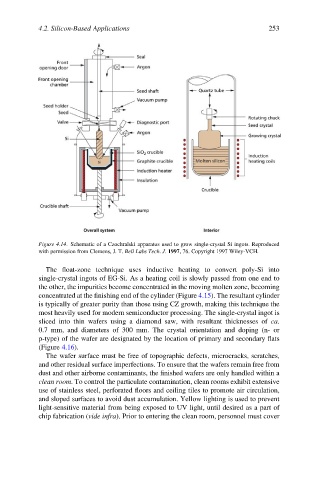
            Figure 4.14. Schematic of a Czochralski apparatus used to grow single-crystal Si ingots. Reproduced
            with permission from Clemens, J. T. Bell Labs Tech. J. 1997, 76. Copyright 1997 Wiley-VCH.

              The float-zone technique uses inductive heating to convert poly-Si into
            single-crystal ingots of EG-Si. As a heating coil is slowly passed from one end to
            the other, the impurities become concentrated in the moving molten zone, becoming
            concentrated at the finishing end of the cylinder (Figure 4.15). The resultant cylinder
            is typically of greater purity than those using CZ growth, making this technique the
            most heavily used for modern semiconductor processing. The single-crystal ingot is
            sliced into thin wafers using a diamond saw, with resultant thicknesses of ca.
            0.7 mm, and diameters of 300 mm. The crystal orientation and doping (n- or
            p-type) of the wafer are designated by the location of primary and secondary flats
            (Figure 4.16).
              The wafer surface must be free of topographic defects, microcracks, scratches,
            and other residual surface imperfections. To ensure that the wafers remain free from
            dust and other airborne contaminants, the finished wafers are only handled within a
            clean room. To control the particulate contamination, clean rooms exhibit extensive
            use of stainless steel, perforated floors and ceiling tiles to promote air circulation,
            and sloped surfaces to avoid dust accumulation. Yellow lighting is used to prevent
            light-sensitive material from being exposed to UV light, until desired as a part of
            chip fabrication (vide infra). Prior to entering the clean room, personnel must cover

