


Page 269 - Materials Chemistry, Second Edition
P. 269
256                                                 4 Semiconductors


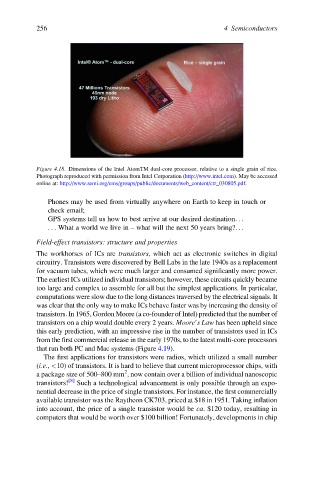
           Figure 4.18. Dimensions of the Intel AtomTM dual-core processor, relative to a single grain of rice.
           Photograph reproduced with permission from Intel Corporation (http://www.intel.com). May be accessed
           online at: http://www.semi.org/cms/groups/public/documents/web_content/ctr_030805.pdf.

              Phones may be used from virtually anywhere on Earth to keep in touch or
              check email;
              GPS systems tell us how to best arrive at our desired destination...
              ... What a world we live in – what will the next 50 years bring?...

           Field-effect transistors: structure and properties
           The workhorses of ICs are transistors, which act as electronic switches in digital
           circuitry. Transistors were discovered by Bell Labs in the late 1940s as a replacement
           for vacuum tubes, which were much larger and consumed significantly more power.
           The earliest ICs utilized individual transistors; however, these circuits quickly became
           too large and complex to assemble for all but the simplest applications. In particular,
           computations were slow due to the long distances traversed by the electrical signals. It
           was clear that the only way to make ICs behave faster was by increasing the density of
           transistors. In 1965, Gordon Moore (a co-founder of Intel) predicted that the number of
           transistors on a chip would double every 2 years. Moore’s Law has been upheld since
           this early prediction, with an impressive rise in the number of transistors used in ICs
           from the first commercial release in the early 1970s, to the latest multi-core processors
           that run both PC and Mac systems (Figure 4.19).
             The first applications for transistors were radios, which utilized a small number
           (i.e., <10) of transistors. It is hard to believe that current microprocessor chips, with
                                    2
           a package size of 500–800 mm , now contain over a billion of individual nanoscopic
                    [8]
           transistors!  Such a technological advancement is only possible through an expo-
           nential decrease in the price of single transistors. For instance, the first commercially
           available transistor was the Raytheon CK703, priced at $18 in 1951. Taking inflation
           into account, the price of a single transistor would be ca. $120 today, resulting in
           computers that would be worth over $100 billion! Fortunately, developments in chip

