


Page 268 - Materials Chemistry, Second Edition
P. 268
255
            4.2. Silicon-Based Applications


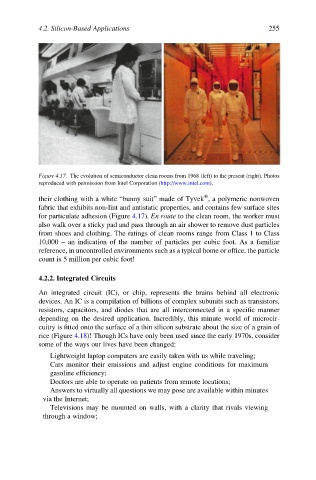
            Figure 4.17. The evolution of semiconductor clean rooms from 1968 (left) to the present (right). Photos
            reproduced with permission from Intel Corporation (http://www.intel.com).

                                                          ®
            their clothing with a white “bunny suit” made of Tyvek , a polymeric nonwoven
            fabric that exhibits non-lint and antistatic properties, and contains few surface sites
            for particulate adhesion (Figure 4.17). En route to the clean room, the worker must
            also walk over a sticky pad and pass through an air shower to remove dust particles
            from shoes and clothing. The ratings of clean rooms range from Class 1 to Class
            10,000 – an indication of the number of particles per cubic foot. As a familiar
            reference, in uncontrolled environments such as a typical home or office, the particle
            count is 5 million per cubic foot!


            4.2.2. Integrated Circuits
            An integrated circuit (IC), or chip, represents the brains behind all electronic
            devices. An IC is a compilation of billions of complex subunits such as transistors,
            resistors, capacitors, and diodes that are all interconnected in a specific manner
            depending on the desired application. Incredibly, this minute world of microcir-
            cuitry is fitted onto the surface of a thin silicon substrate about the size of a grain of
            rice (Figure 4.18)! Though ICs have only been used since the early 1970s, consider
            some of the ways our lives have been changed:
               Lightweight laptop computers are easily taken with us while traveling;
               Cars monitor their emissions and adjust engine conditions for maximum
               gasoline efficiency;
               Doctors are able to operate on patients from remote locations;
               Answers to virtually all questions we may pose are available within minutes
             via the Internet;
               Televisions may be mounted on walls, with a clarity that rivals viewing
             through a window;

