


Page 305 - Mathematical Models and Algorithms for Power System Optimization
P. 305
Local Decoupling Control Method for Transient Stability of a Power System 297
T T
_ _ _ _
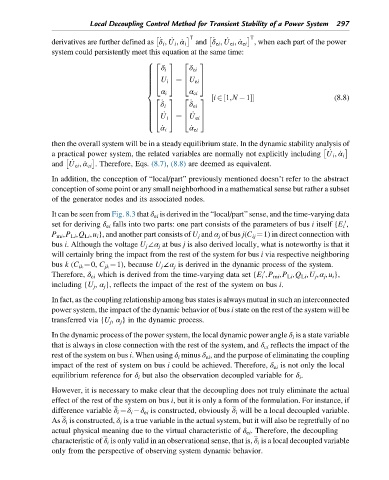
derivatives are further defined as δ i , U i , _ α i and δ ei , U ei , _ α ei , when each part of the power
system could persistently meet this equation at the same time:
8
2 3 2 3
δ i δ ei
>
>
>
>
6 7 6 7
>
>
4 U i 5 ¼ U ei 5
4
>
>
>
<
α i α ei
3 i 2 1,N 1½½ (8.8)
_ _
2 3 2
> δ i δ ei
>
>
>
6 _ 7 6 _ 7
>
>
> 4 U i 5 ¼ U ei 5
4
>
>
:
_ α i _ α ei
then the overall system will be in a steady equilibrium state. In the dynamic stability analysis of
_
a practical power system, the related variables are normally not explicitly including U i , _ α i
_
and U ei , _ α ei . Therefore, Eqs. (8.7), (8.8) are deemed as equivalent.
In addition, the conception of “local/part” previously mentioned doesn’t refer to the abstract
conception of some point or any small neighborhood in a mathematical sense but rather a subset
of the generator nodes and its associated nodes.
It can be seen from Fig. 8.3 that δ ei is derived in the “local/part” sense, and the time-varying data
set for deriving δ ei falls into two parts: one part consists of the parameters of bus i itself {E i ,
0
P mi ,P Li ,Q Li ,u i }, and another part consists of U j and α j of bus j(C ij ¼1) in direct connection with
bus i. Although the voltage U j ∠α j at bus j is also derived locally, what is noteworthy is that it
will certainly bring the impact from the rest of the system for bus i via respective neighboring
bus k (C ik ¼0, C jk ¼1), because U j ∠α j is derived in the dynamic process of the system.
0
Therefore, δ ei which is derived from the time-varying data set {E i ,P mi ,P Li ,Q Li ,U j ,α j ,u i },
including {U j , α j }, reflects the impact of the rest of the system on bus i.
In fact, as the coupling relationship among bus states is always mutual in such an interconnected
power system, the impact of the dynamic behavior of bus i state on the rest of the system will be
transferred via {U j , α j } in the dynamic process.
In the dynamic process of the power system, the local dynamic power angle δ i is a state variable
that is always in close connection with the rest of the system, and δ ei reflects the impact of the
rest of the system on bus i. When using δ i minus δ ei , and the purpose of eliminating the coupling
impact of the rest of system on bus i could be achieved. Therefore, δ ei is not only the local
equilibrium reference for δ i but also the observation decoupled variable for δ i .
However, it is necessary to make clear that the decoupling does not truly eliminate the actual
effect of the rest of the system on bus i, but it is only a form of the formulation. For instance, if
difference variable δ i ¼δ i δ ei is constructed, obviously δ i will be a local decoupled variable.
As δ i is constructed, δ i is a true variable in the actual system, but it will also be regretfully of no
actual physical meaning due to the virtual characteristic of δ ei . Therefore, the decoupling
characteristic of δ i is only valid in an observational sense, that is, δ i is a local decoupled variable
only from the perspective of observing system dynamic behavior.

