


Page 309 - Mathematical Models and Algorithms for Power System Optimization
P. 309
Local Decoupling Control Method for Transient Stability of a Power System 301
π π
ð
ij
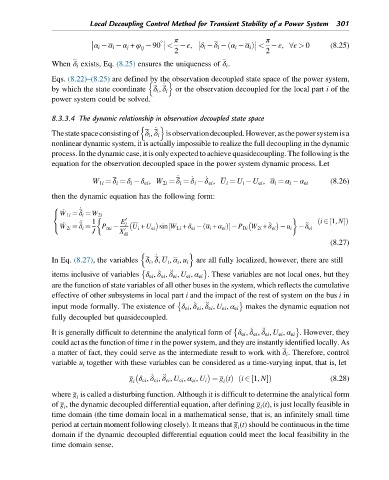
α i α i α j + φ 90 < ε, δ i δ i α i α i Þ < ε, 8ε > 0 (8.25)
°
2 2
When δ i exists, Eq. (8.25) ensures the uniqueness of δ i .
Eqs. (8.22)–(8.25) are defined by the observation decoupled state space of the power system,
n _ o
by which the state coordinate δ i , δ i or the observation decoupled for the local part i of the
power system could be solved.
8.3.3.4 The dynamic relationship in observation decoupled state space
_
n o
Thestatespaceconsistingof δ i , δ i isobservationdecoupled.However,asthepowersystemisa
nonlinear dynamic system, it is actually impossible to realize the full decoupling in the dynamic
process. In the dynamiccase, it is only expected to achieve quasidecoupling.The following is the
equation for the observation decoupled space in the power system dynamic process. Let
_ _ _
W 1i ¼ δ i ¼ δ i δ ei , W 2i ¼ δ i ¼ δ i δ ei , U i ¼ U i U ei , α i ¼ α i α ei (8.26)
then the dynamic equation has the following form:
8
_ _
< W 1i ¼ δ i ¼ W 2i
0
½
_ € 1 E _ € ð i 2 1, NÞ
i
W 2i ¼ δ i ¼ P mi ½ ð
: U i + U ei sin W Li + δ ei α i + α ei Þ P Di W 2i + δ ei u i δ ei
J X 0
di
(8.27)
_
n o
In Eq. (8.27), the variables δ i , δ, U i , α i , u i are all fully localized, however, there are still
_
€
items inclusive of variables δ ei , δ ei , δ ei , U ei , α ei . These variables are not local ones, but they
are the function of state variables of all other buses in the system, which reflects the cumulative
effective of other subsystems in local part i and the impact of the rest of system on the bus i in
_ €
input mode formally. The existence of δ ei , δ ei , δ ei , U ei , α ei makes the dynamic equation not
fully decoupled but quasidecoupled.
_
€
It is generally difficult to determine the analytical form of δ ei , δ ei , δ ei , U ei , α ei . However, they
could act as the function of time t in the power system, and they are instantly identified locally. As
a matter of fact, they could serve as the intermediate result to work with δ i . Therefore, control
variable u i together with these variables can be considered as a time-varying input, that is, let
_ €
½
g δ ei , δ ei , δ ei , U ei , α ei , U i ¼ g tðÞ i 2 1, NÞ (8.28)
ð
i
i
where g is called a disturbing function. Although it is difficult to determine the analytical form
i
of g , the dynamic decoupled differential equation, after defining g (t), is just locally feasible in
i
i
time domain (the time domain local in a mathematical sense, that is, an infinitely small time
period at certain moment following closely). It means that g (t) should be continuous in the time
i
domain if the dynamic decoupled differential equation could meet the local feasibility in the
time domain sense.

