


Page 314 - Mathematical Models and Algorithms for Power System Optimization
P. 314
306 Chapter 8
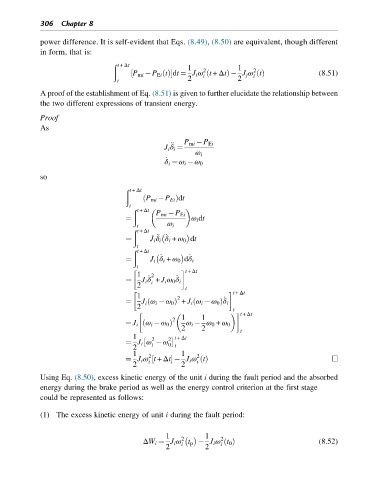
power difference. It is self-evident that Eqs. (8.49), (8.50) are equivalent, though different
in form, that is:
t + Δt
ð
1 2 1 2
½ P mi P Ei tðÞdt ¼ J i ω t + ΔtÞ J j ω tðÞ (8.51)
ð
i
i
t 2 2
A proof of the establishment of Eq. (8.51) is given to further elucidate the relationship between
the two different expressions of transient energy.
Proof
As
€ P mi P Ei
J i δ i ¼
ω i
_
δ i ¼ ω i ω 0
so
t + Δt
ð
ð P mi P Ei Þdt
t
t + Δt
ð
P mi P Ei
¼ ω i dt
t ω i
ð t + Δt
€ _
¼ J i δ i δ i + ω 0 dt
t
ð t + Δt
_ _
¼ J i δ i + ω 0 dδ i
t
t + Δt
1 2
_
_
¼ J i δ + J i ω 0 δ i
i
2
t
t + Δt
1 2
_
ð
¼ J i ω i ω 0 Þ + J i ω i ω 0 Þδ i
ð
2
t
t + Δt
2 1 1
ð
¼ J i ω i ω 0 Þ ω i ω 0 + ω 0
2 2
t
2
1
¼ J i ω ω 2 t + Δt
2 i 0 t
1 1
2
2
¼ J i ω t + Δt J i ω tðÞ h
½
i
i
2 2
Using Eq. (8.50), excess kinetic energy of the unit i during the fault period and the absorbed
energy during the brake period as well as the energy control criterion at the first stage
could be represented as follows:
(1) The excess kinetic energy of unit i during the fault period:
1 1
2 2
ðÞ
ΔW i ¼ J i ω t p J i ω t 0 (8.52)
i
i
2 2

