


Page 315 - Mathematical Models and Algorithms for Power System Optimization
P. 315
Local Decoupling Control Method for Transient Stability of a Power System 307

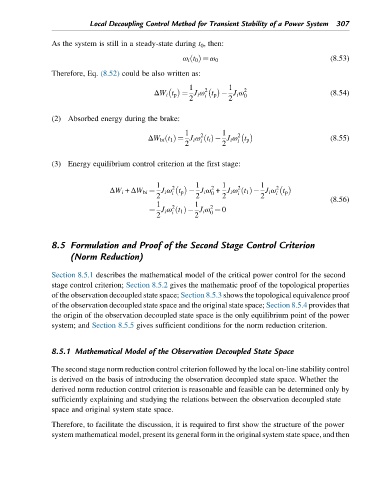
               As the system is still in a steady-state during t 0 , then:

                                                      ðÞ
                                                    ω i t 0 ¼ ω 0                            (8.53)
               Therefore, Eq. (8.52) could be also written as:

                                                     1          1
                                                          2

                                            ΔW i t p ¼ J i ω t p   J i ω 2                   (8.54)
                                                     2    i     2    0
               (2) Absorbed energy during the brake:
                                                    1    2     1   2
                                               ðÞ
                                          ΔW bi t 1 ¼ J i ω t i ðÞ  J i ω t p                (8.55)
                                                         i
                                                                   i
                                                    2          2
               (3) Energy equilibrium control criterion at the first stage:

                                            1    2      1   2  1   2     1    2
                                                                    ðÞ
                               ΔW i + ΔW bi ¼ J i ω t p   J i ω + J i ω t 1   J i ω t p
                                                 i
                                                                   i
                                                                              i
                                                            0
                                            2          2       2         2                   (8.56)
                                            1    2     1   2
                                          ¼ J i ω t 1   J i ω ¼ 0
                                                  ðÞ
                                                 i
                                                           0
                                            2          2
               8.5 Formulation and Proof of the Second Stage Control Criterion
                     (Norm Reduction)
               Section 8.5.1 describes the mathematical model of the critical power control for the second
               stage control criterion; Section 8.5.2 gives the mathematic proof of the topological properties
               of the observation decoupled state space; Section 8.5.3 shows the topological equivalence proof
               of the observation decoupled state space and the original state space; Section 8.5.4 provides that
               the origin of the observation decoupled state space is the only equilibrium point of the power
               system; and Section 8.5.5 gives sufficient conditions for the norm reduction criterion.


               8.5.1 Mathematical Model of the Observation Decoupled State Space

               The second stage norm reduction control criterion followed by the local on-line stability control
               is derived on the basis of introducing the observation decoupled state space. Whether the
               derived norm reduction control criterion is reasonable and feasible can be determined only by
               sufficiently explaining and studying the relations between the observation decoupled state
               space and original system state space.

               Therefore, to facilitate the discussion, it is required to first show the structure of the power
               system mathematical model, present its general form in the original system state space, and then

